
Osmanthus: A Classic Evergreen Bringing Structure and Fragrance to the Garden
By Corinne Kennedy
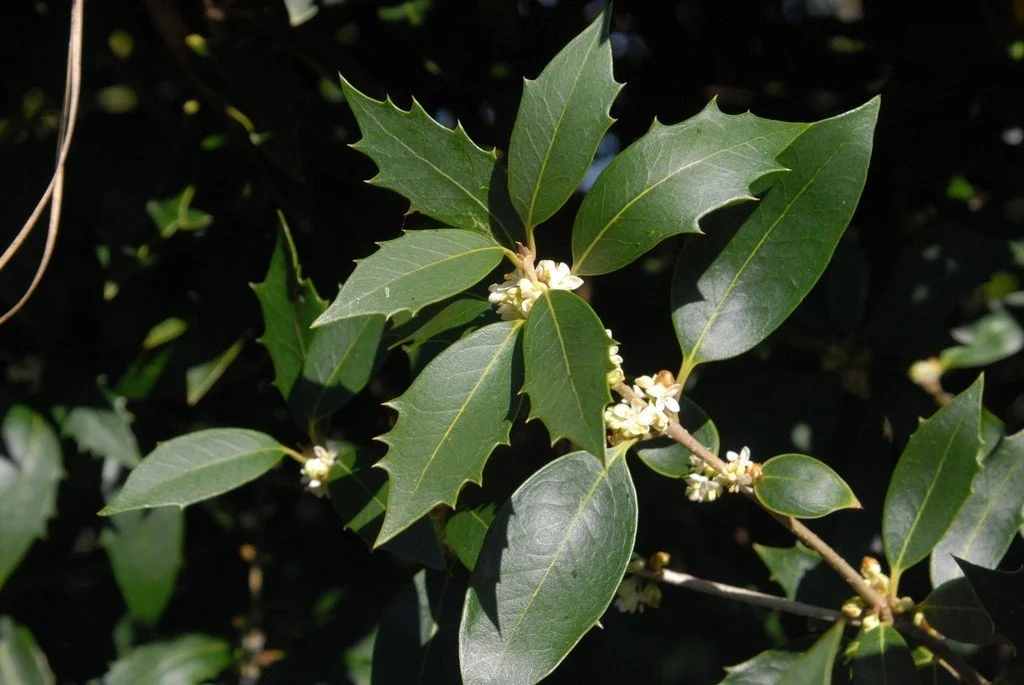
Holly leaf osmanthus (Osmanthus heterophyllus), with its two leaf forms and tiny fragrant flowers. (photo: Jim Robbins, CC BY-NC-ND 4.0)
“I find Osmanthus (Greek, meaning “fragrant flower”) … to be an aristocratic and highly refined member of the olive family” [Dan Hinkley, in The Explorer’s Garden: Shrubs and Vines From the Four Corners of the World, 2009]
“Many of my fond memories of autumn are associated with the wafting fragrance of sweet olives. Wherever they are encountered… the aroma of warm, baked apricots follows.” [Sean Hogan, in Trees for All Seasons: Broadleaf Evergreens for Temperate Climates, 2008]
The genus Osmanthus consists of about 30 species of shrubs and small trees noteworthy for their small, very fragrant flowers and attractive evergreen foliage. In fact, the word Osmanthus derives from the Greek words osme (fragrant) and anthos (flower). In general, its plants are tough and adaptable—and unless stressed, without serious disease or pest problems, including damage caused by rabbits. They deserve to be much better known and more widely planted in the Pacific Northwest and other temperate areas of this country.
The Seattle Japanese Garden contains two species and one hybrid within this genus (totaling more than 25 plants). Osmanthus is a member of the olive family (Oleaceae), which includes many other plants with fragrant flowers (e.g., lilacs, jasmines, and true olive trees). In fact, the common name “sweet olive” is sometimes used to refer very generally to all plants within the genus.
Most species are native to woodlands in the temperate areas of Southeast Asia, but the genus also includes two species native to the Western Hemisphere and many cultivated varieties (cultivars, also known as “garden varieties”). In China and Japan, Osmanthus shrubs and trees have long been planted as ornamentals. And as broadleaf evergreens, they’re essential elements in traditional Japanese gardens—though less prominently iconic than pines and maples.
Bold Foliage: Osmanthus heterophyllus
Osmanthus heterophyllus (formerly known as O. ilicifolius) is a fall-blooming species native to Japan and Taiwan, where it grows in rocky places and woodlands. This species is noteworthy for its cold hardiness, adaptability, and the boldness of its holly-like foliage. The Seattle Japanese Garden contains six plants, located south of the Garden’s original gate (Areas I) and on its northern hillside (Areas O and S). This summer and fall, the northern end of the Garden is fenced off for construction of the ishigaki wall and accessible pathway, but the large Area I plant, about 13 feet tall, is easily viewed from the Garden’s east-side path.
With its spiny leaves, people often mistake this species for a true holly (Ilex), but like all Osmanthus species, its leaves ae held opposite each other on their stems. (Ilex, on the other hand, has alternating leaves.) Common names include holly leaf osmanthus, holly tea olive, and false holly.
In fact, the species word heterophyllus means “having the foliage leaves of more than one form on the same plant or stem.” As described by Sean Hogan—horticulturalist, author, and long-time owner of Cistus Design Nursery:
“Young plants have leaves that are heavily toothed, indeed, much like Ilex aquifolium…. As the plants mature, they lose most of their marginal teeth, becoming nearly entire with only serrations.”
Both foliage kinds are oval, thick, waxy in texture, glossy dark green, and about 2 ½ inches long.
Osmanthus heterophyllus grows at a moderate rate to a mature size of about 15 feet tall. It has an upright habit when young but widens with age. In its native range, it eventually becomes treelike and may exceed 30 feet in height. This species blooms in late September and October, with fragrant tubular white flowers that are mostly hidden by the foliage. The tiny flowers, held in small clusters at the junctions of leaves and stems, are about ¼ inch across, with 4 lobes and reflexed petals. Fruiting is uncommon.
Hardy to USDA Zone 6 (minimum temperature, -10 to 0 degrees Fahrenheit), holly leaf osmanthus grows well in sun or part shade, and prefers moist, fertile, well-drained, acid soil. However, it tolerates drought, stressful urban conditions, and somewhat alkaline soils. Although not problematic here in the Pacific Northwest, it can become invasive in our country’s mid-Atlantic region.
In Japan, Osmanthus heterophyllus was first mentioned in the 8th century—in the Kojiki, its oldest surviving historical record. It’s been widely planted there, either pruned as a hedge or grown as a focal-point shrub or small tree, retaining its natural form.
Variations: Two Attractive Cultivars of Osmanthus heterophyllus
The Seattle Japanese Garden also contains two cultivars of Osmanthus heterophyllus.
Osmanthus heterophyllus ‘Variegatus’ (variegated holly leaf osmanthus) grows on the Garden’s east side (Area D), near the fence and hidden by other shrubs. A larger specimen is planted on the Garden’s northern hillside (in Area M) and is usually well visible from the path—although not during this year’s ishigaki wall project.
The very attractively patterned foliage of ‘Variegatus’ is medium green, edged in creamy white—and less stiffly spiny than that of the species. It grows well in part shade or full sun but should not be planted where structures or pavement create reflected heat.
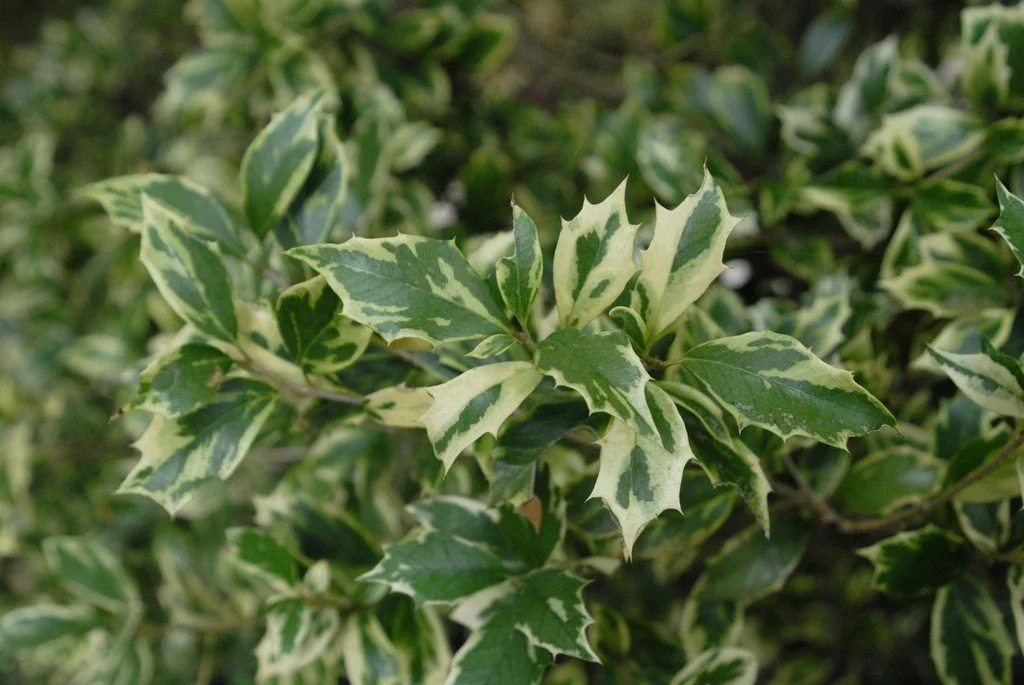
The attractively patterned foliage of Osmanthus heterophyllus ‘Variegatus’. (photo: Jim Robbins, CC BY-NC-ND 4.0)
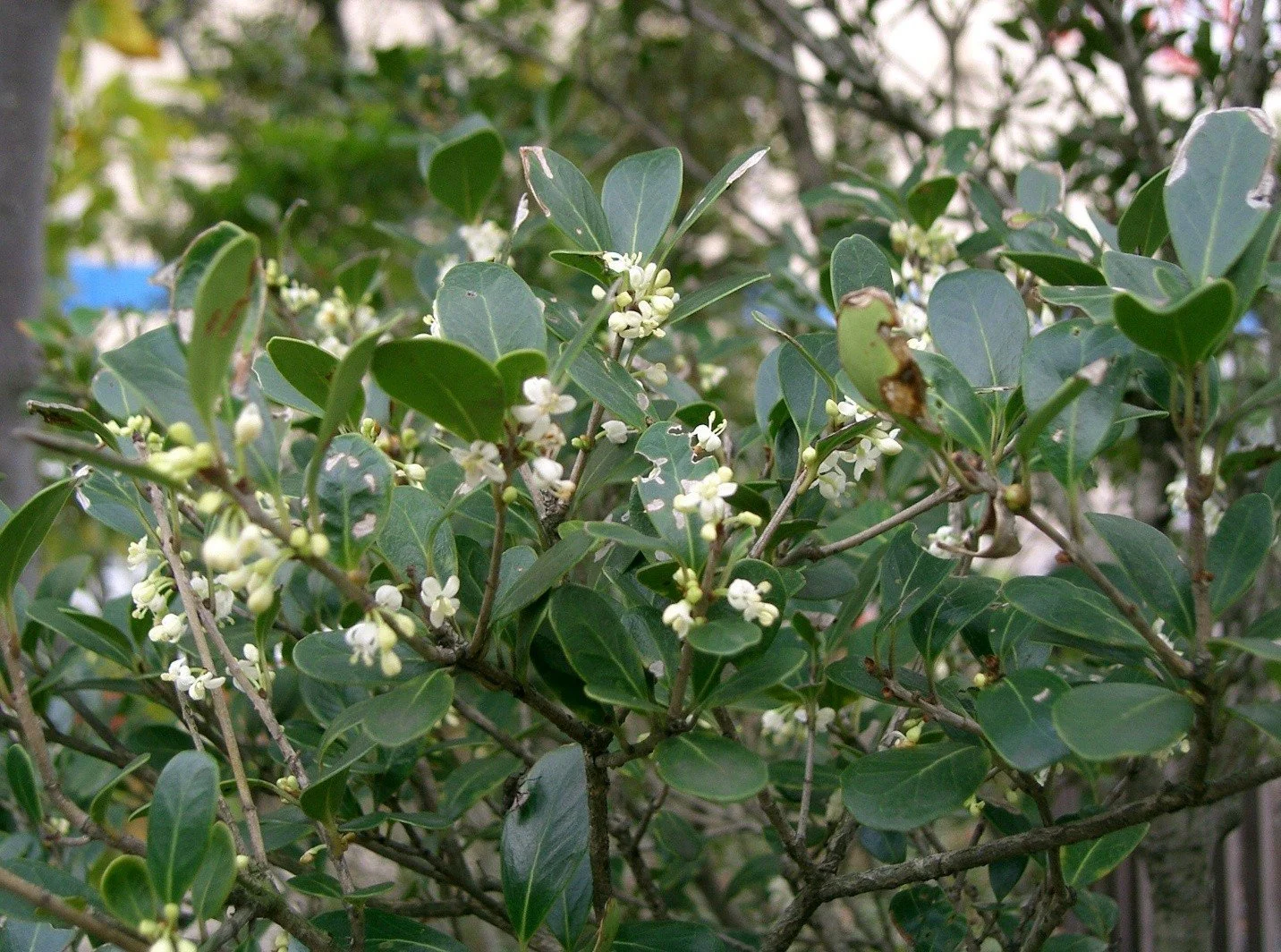
The rounded leaves and white flowers of Osmanthus heterophyllus ‘Rotundifolius’. (photo: Kenpei, Nov. 16, 2006, GFDL, Creative Commons Attribution ShareAlike 2.1 Japan License)
Osmanthus heterophyllus ‘Rotundifolius’ (round-leaf holly osmanthus) grows on the northern hillside, below the Kobe Lantern (Area O, not easily seen during this year’s construction) and within the tea garden (in Area W). This cultivar has fragrant flowers and rounded, blunt-tipped, spineless foliage—hence the name ‘Rotundifolius’, which means “round-leaved.” It’s slightly less cold hardy than the species.
Both cultivars are slower growing than the species plant, with the mature height of ‘Variegatus’ (about 12 feet) about twice that of ‘Rotundifolius’.
Additional cultivars have been developed—all more widely grown and available for purchase than Osmanthus heterophyllus. Although not planted in our Garden, ‘Goshiki’ is a very popular variegated cultivar with a mature height of about 10 feet. In addition to a green background, its leaves include spots and swirls of cream, pink, orange, yellow and white.
Culturally Important in China and Japan: Osmanthus fragrans
Like holly leaf osmanthus, Osmanthus fragrans displays peak bloom in late summer and autumn. (However, in areas where winters are mild, occasional flowering may persist into winter and spring.) Commonly known as fragrant tea olive, fragrant olive and sweet osmanthus, this species and its cultivars are widely considered to have the most fragrant flowers within the genus. In the Seattle Japanese Garden, several plants were planted relatively recently near the shortcut paths at the southern end of the pond (in Areas F and H). Unfortunately for visitors interested in purchasing plants for their own gardens, this species may only be available from specialty or rare-plant nurseries.
Sweet osmanthus is the least cold hardy of our Garden’s osmanthus plants—to about USDA Zone 8 (minimum temperature 10 to 20 degrees Fahrenheit). According to Sean Hogan:
“Probably more than for any other Osmanthus species, frost hardiness is dependent on the amount of summer warmth received. In cool and coastal climates, new growth might appear late; flushes of new growth, having had no time to harden in autumn, are most subject to blackening from cold. Overhead cover or southern exposure to achieve more heat accumulation is certainly helpful.”
With the realities of climate change since the 2008 publication of Hogan’s Trees for All Seasons: Broadleaf Evergreens for Temperate Climates, the above explanation may require some revision. However, with its widespread distribution in the wild and long history of cultivation, numerous forms are in existence—some with increased cold hardiness.
Osmanthus fragrans is native to moist woodlands in China, Japan, and the Himalayas. In cultivation, its mature size is about 10 feet tall by 8 feet wide, with an upright oval habit. However, very old plants growing in the wild—or in very mild conditions outside of Southeast Asia—may eventually exceed 30 feet tall. Sweet osmanthus grows best in acidic, well-drained soil, in full sun to part shade. Although moderately drought tolerant when established, it requires occasional watering during our region’s dry summers.
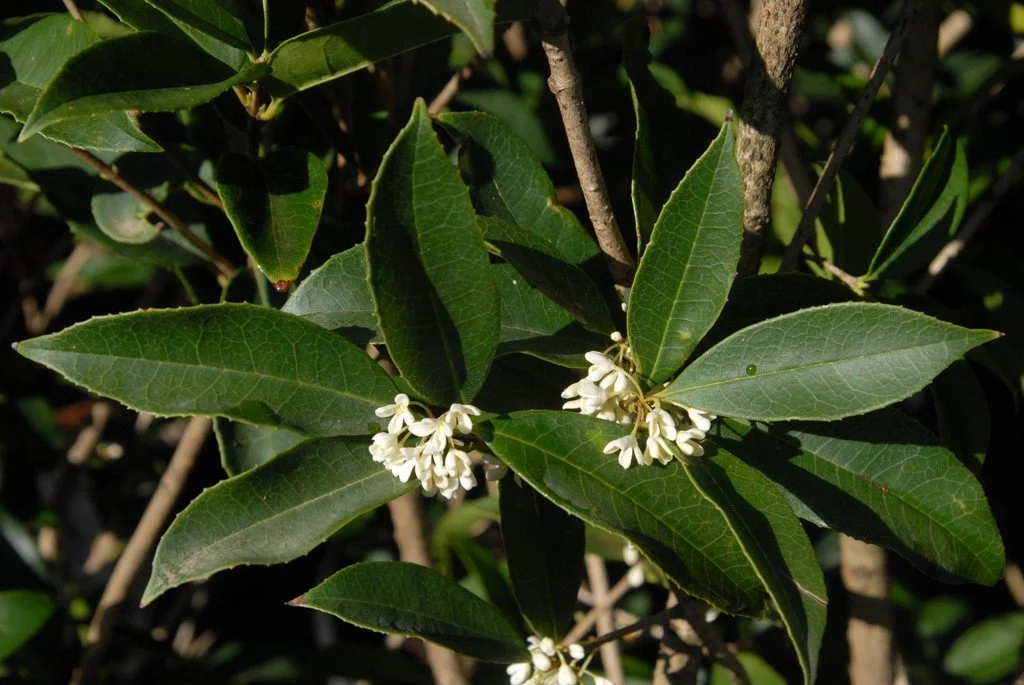
Foliage and flowers of sweet osmanthus (Osmanthus fragrans). (photo: Jim Robbins, CC BY-NC-ND 4.0)
The somewhat leathery, finely toothed or smooth-edged medium green leaves are long and narrow (up to 6 inches long). Flowers are small (less than ½ inch wide), very fragrant, 4-lobed, and held singly or in small clusters. Usually white or creamy white, they are sometimes orangish in color. Their scent has been described as a blend of jasmine, gardenia, and ripe apricots. In warm climates, plants form dark purple/black fruits.
Osmanthus fragrans is one of China’s most popular and culturally important garden plants. Its flowers have been used for centuries in teas, foods, traditional medicine, and cosmetics. It was introduced from China to Japan during the Edo period (1603 CE–1868 CE) and has long been viewed there as a harbinger or symbol of autumn. Grown naturally or pruned into a hedge, it’s been widely planted in parks, in gardens, and on the grounds of shrines and temples. In Japan, however, cosmetics using the flower’s essential oils have appeared on the market only relatively recently. (Unfortunately, in the mid-20th century this fragrance was widely used in commercial air-fresheners, a negative association that persists in the memories of Japan’s older residents.)
A Versatile Spring-Blooming Hybrid: Osmanthus x burkwoodii
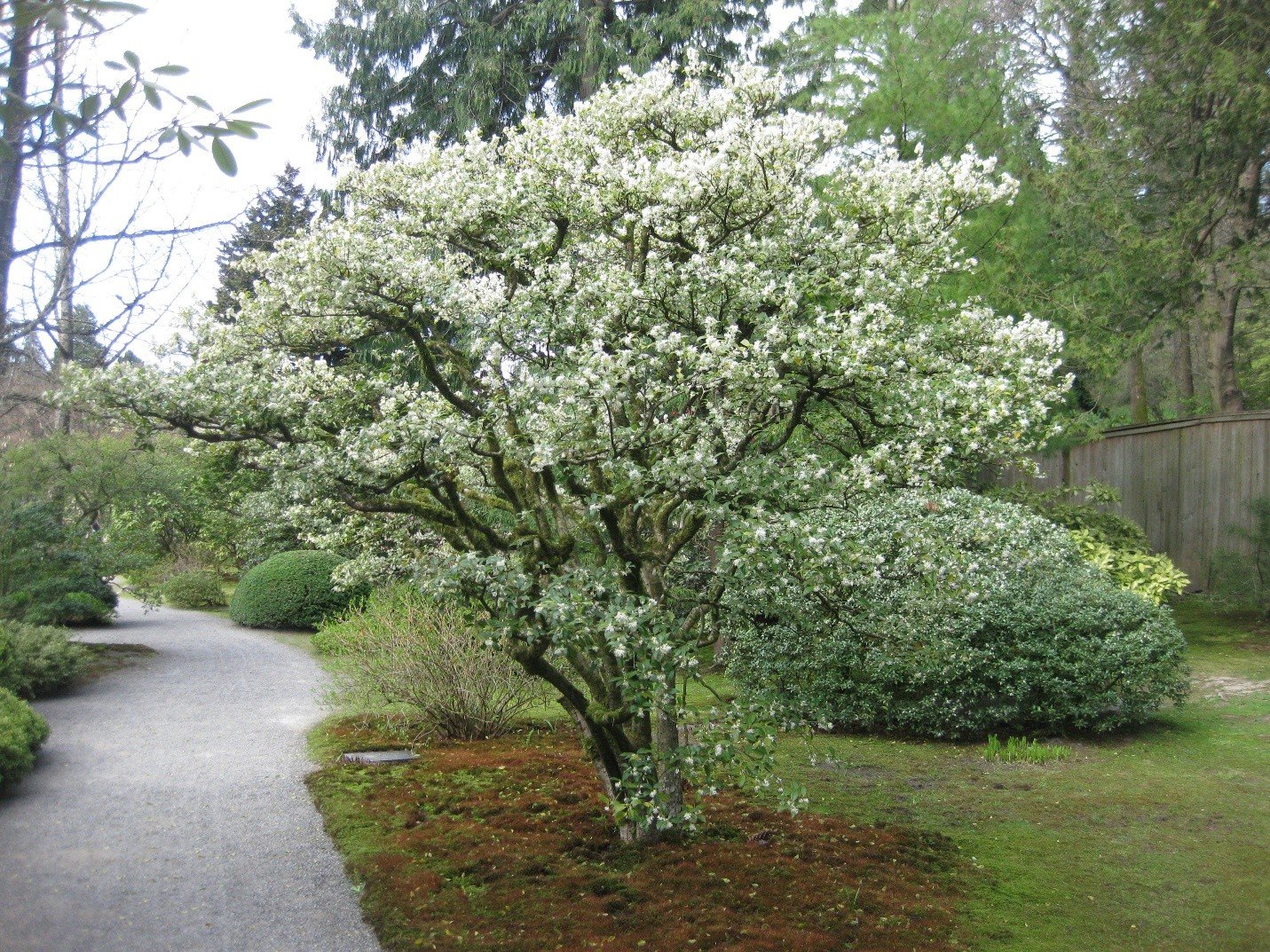
Burkwood osmanthus (Osmanthus x burkwoodii), next to the path in Area D. (photo: Aleks Monk, 4/1/13)
Osmanthus x burkwoodii, the Seattle Japanese Garden’s most prominent osmanthus, flowers exclusively in the spring. About 15 shrubs are planted in seven areas throughout the Garden.
This cultivar was created in the late 1920s by the English nurserymen Burkwood and Skipwith. The “x” in the botanical name indicates that it’s a cross between two osmanthus species—Osmanthus delavayi and Osmanthus decorus (natives of Yunnan and Western Asia, respectively). Common names include hybrid osmanthus and Burkwood osmanthus.
[Plant geek note: this cultivar was originally named x Osmarea burkwoodii) because its parents were then known as Osmanthus delavayi and Phillyrea decora—so the new plant was classified as a “bi-generic hybrid.” But Phillyrea decora was soon reclassified as Osmanthus decorus, resulting in the hybrid’s current botanical name.]
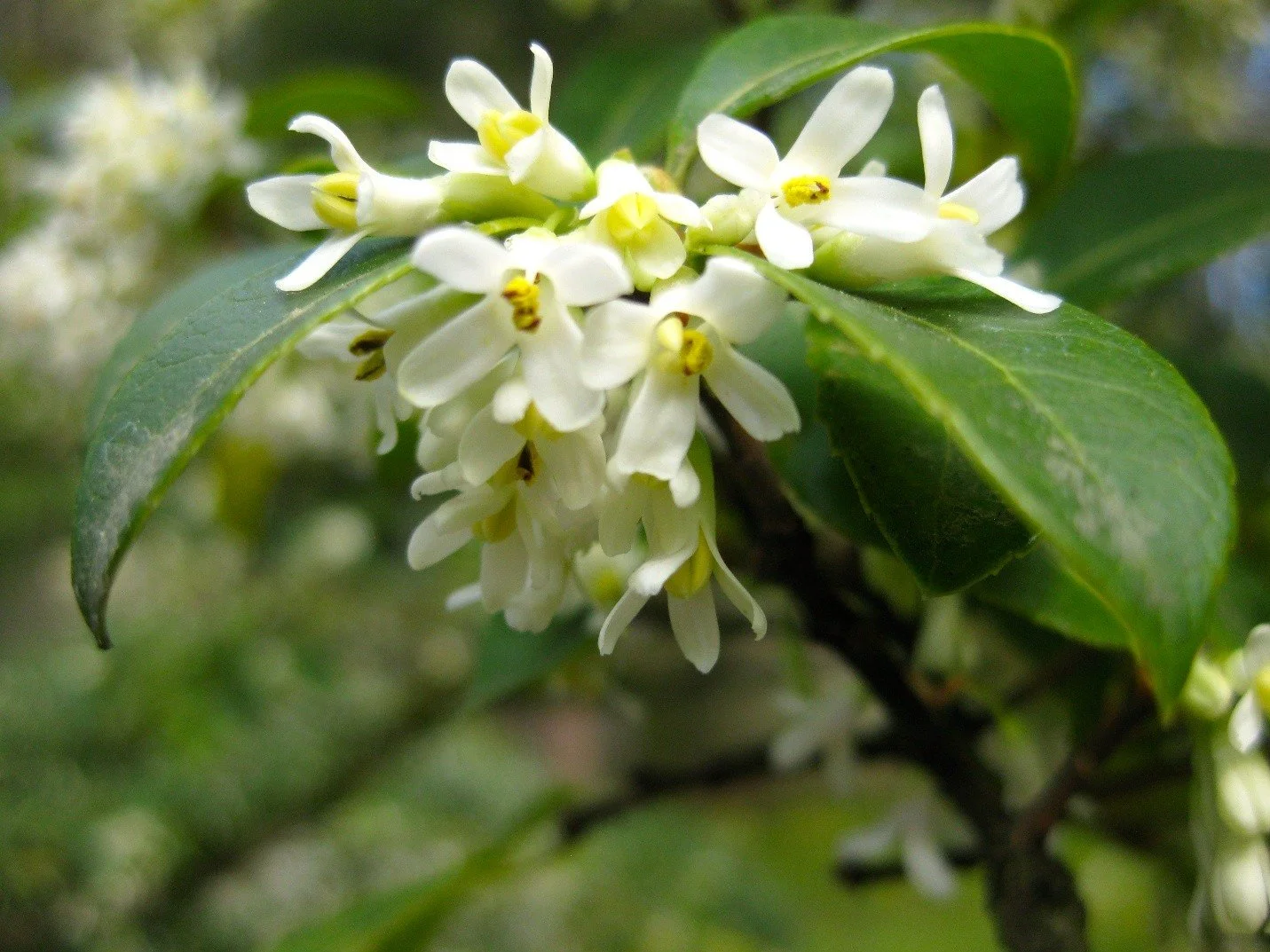
Flowers and foliage of Burkwood osmanthus (Osmanthus x burkwoodii), in Area D. (photo: Aleks Monk, 4/1/13)
Osmanthus x burkwoodii is a dense evergreen shrub with a mature size of about 10 feet tall and wide. Over time, it can be allowed to grow much larger and treelike—or with regular pruning maintained as a compact 6-foot-tall shrub. Its small, leathery, glossy green, and very slightly toothed leaves are 1 to 2 inches long. Thus, its overall appearance is more delicate than that of the coarser-leaved Osmanthus heterophyllus. Fragrant, creamy white, 4-lobed flowers open in March and April. They’re not as intensely fragrant as the latter’s blooms. However, the two plants have relatively similar growth rates, preferred conditions, and tendency not to fruit. Both take well to pruning.
Cold hardy to at least USDA Zone 7 (minimum temperature 0 to 10 degrees Fahrenheit), Burkwood osmanthus is a tough and adaptable plant. It grows best in well-drained soil, in full sun to light shade, and is drought tolerant when established. However, it tolerates deep shade (though flowering is reduced) and even clay or sandy soils. During our region’s dry summers, occasional watering is needed.
Combining beauty and adaptability, and hardier than O. delavayi, the parent it most resembles, Burkwood osmanthus is deservedly popular. It’s widely grown by wholesale nurseries and usually available for retail purchase in spring. Garden writers often recommend osmanthus shrubs that bloom in the fall because fewer plants are flowering then. But a strong case can also be made for the early spring flowers of Osmanthus x burkwoodii. Their delicate fragrance pulls me out of my winter hibernation—and invites our Garden’s visitors to participate in its spring awakening.
In Summary
The genus Osmanthus is noteworthy for its rich, complex floral fragrances and for the evergreen structure its shrubs and trees bring to a variety of garden designs. Tough and adaptable, they are also pest and disease resistant. And as broadleaf evergreen plants, they’re essential elements within traditional Japanese-style gardens, including our own. They deserve to be much better known and more widely planted in the Pacific Northwest and other temperate areas of this country.
As a docent since 2013, I’ve observed the realities of climate change in the Seattle Japanese Garden as well as in my own garden. I’m hopeful that the genus Osmanthus will continue to be an important element here—and an essential contributor to our Garden’s future resilience.
Corinne Kennedy is a Garden Guide, frequent contributor to the Seattle Japanese Garden blog, and retired garden designer.