
Design and Maintenance in the Seattle Japanese Garden—Part Two: The Legacy of Richard Iwao Yamasaki
By Corinne Kennedy
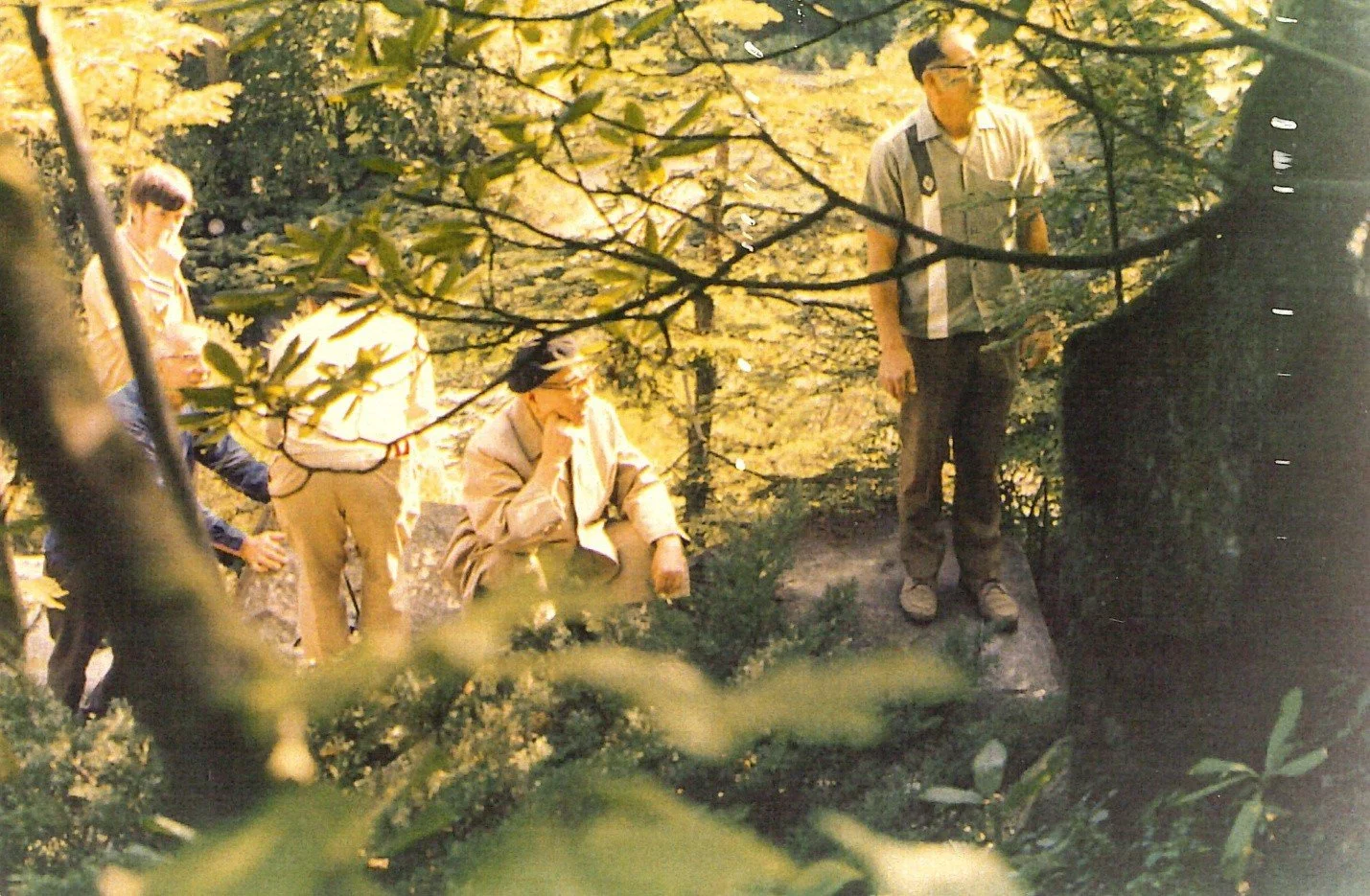
Richard Yamasaki (right) with Jūki Iida (middle) in the Seattle Japanese Garden. (photo: July 1973. https://www.seattlejapanesegarden.org/blog/2024/2/20/toro-no-akari-jim-thomas)
This is the second in a series of articles on design and maintenance in the Seattle Japanese Garden (SJG), focusing on Richard Iwao Yamasaki’s important role, not only during the Garden’s 1960 creation but also in the years that followed. In the past, I’ve written several blog articles about specific contributions, in various years, that he made to the Garden. Here, though, my goal is to present Richard Yamasaki’s story more holistically, revealing his essential role over many decades in the Garden’s long history of stewardship and mentoring.
As in Part One of this series, I’ll bring together information from documents published over many years, including articles published on various websites and in the Washington Park Arboretum Bulletin.
What follows is the story of Dick Yamasaki’s life and many contributions to our Garden.
1921-1941—An Early History of Gardening:
Richard Iwao Yamasaki, known as Dick, was born on August 19, 1921, to Masagoro “George” Yamasaki & Umi Kawahara Yamasaki. His younger brother Bill (William Akira Yamasaki) was born in 1923. Masagoro had immigrated to the U.S. in 1919 at the age of 31, but both sons were Nisei, second generation Japanese Americans and thus American citizens. According to the 1930 US Census, the family lived in a rental house on Beacon Hill and Masagoro worked as a landscape gardener.
Sometime in the 1920s, one of Masagoro’s wealthy clients gave him a young Japanese black pine (Pinus thunbergii). He planted at their home and trained in the Japanese style—hand-pinching the new growth in spring and pruning in fall. As Dick and Bill grew up, they assisted their father in his gardening business and in pruning the black pine.
First-generation Japanese immigrants (Issei) were prohibited from owning property in Washington State, so a common strategy of Japanese American families was to hold or own property and/or businesses in the name of their oldest American-born child. [To determine whether the Yamasaki house had remained a rental, I contacted the Washington State Archives and learned that the “property record card” for 3510 Holly St. shows Richard I. Yamasaki as its owner/occupier.]
1942-1959—Incarceration During World War II and the Post-War Period:
Two months after the December 1941 attack on Pearl Harbor, President Roosevelt issued Executive Order 9066, establishing the legal authority to incarcerate nearly 120,000 Japanese American civilians living in the “exclusion zone” (western Washington, all of Oregon and California, and southern Arizona). They were forcibly taken from their homes and incarcerated in ten so-called “relocation camps,” the majority located in remote, desolate areas of the Western U.S. The Yamasaki family was among those imprisoned.
Dick was incarcerated in 1942 at Minidoka, Idaho. It’s likely that he and Fumiko Hayashi were married there sometime before February 1943, when Fumi was sent to the Heart Mountain camp. [Records are inconsistent, but some sources report that Dick was also sent to Heart Mountain. If so, they may have married at Heart Mountain or perhaps even later, after the war ended.] Fortunately, both were permitted to leave camp on June 30, 1943, for an employment opportunity in Buhl, Idaho.
During the incarceration, the family lost everything except for their Holly St. house, which had been cared for by a neighbor. Thus, after the war, in 1945 or 1946, Dick and Fumi were able to move back to Dick’s childhood home. He and Bill began rebuilding the family’s landscaping business and pruning the family’s black pine. Their father, however, resettled in Portland with his second wife.
1960-1981—Working with Jūki Iida, Building and Maintaining the SJG:
The Seattle Japanese Garden’s design was a gift from the Tokyo Metropolitan Park Department, which chose Jūki (sometimes spelled Juuki) Iida, a renowned master of Japanese garden design, to supervise its construction. In all, seven Japanese designers, including Iida, collaborated to develop the plan. Iida’s accomplishment is aptly summarized on the Elisabeth C. Miller Library website:
“He took the space designated in Washington Park and infused it with his deep understanding of Japanese gardens.”
Three Japanese American landscape contractors were chosen to build the Garden, including the Yamasaki Landscape Company, selected for rockwork. According to Dick, the andesitic stones used to create the Garden’s prominent rock wall came from Black River Quarry, near North Bend, and the sandstone cut pavers in the harbor area below the wall came from Wilkeson Quarry, at the north entrance to Mount Rainier. The Garden’s granite boulders, including the 8+ ton stone forming its waterfall, came from private property on Bandera Mountain, near Snoqualmie Pass.
Construction began during the winter of 1959-60 and proceeded quickly, expedited by the use of heavy construction equipment for general earthmoving and massive rockwork. Dick and Bill placed the Garden’s stones under Jūki Iida’s direction, and a deep mentoring relationship began to develop. The Garden’s official opening was held on June 5, 1960.
While in Seattle, Iida brushed a sumi ink paper scroll (7 ½” high by 101” long), representing the essential elements of Japanese gardens—trees, rocks, and water. Working in the evenings, he finished the scroll before he left Seattle, when he gifted it to Dick.
Soon after the Garden opened, it became evident that its east entrance location was ill-chosen. The original entrance, known as the Emperor’s Gate, was too small and too far from the large parking lot south of the Garden. In addition, visitors approaching the entrance had to walk along dangerously fast traffic on Lake Washington Boulevard East. A re-design and added plantings were urgently needed, so in the fall and winter of 1960-61, University of Washington landscape architect Eric Hoyte, together with Richard Yamasaki, designed and created a new southern entrance. The new area also included a powerful rock arrangement, located on the left side of the path, near the Garden’s iconic weeping Japanese maple. [Seattle landscape architect Koichi Kobayashi verified that Yamasaki had designed and placed this rock arrangement, which isn’t typical of other Iida gardens, or of other rock arrangements within the Seattle Japanese Garden.]
Dick’s connection to the SJG during the mid to late 1960s is unclear, and during that time his Yamasaki Landscape Company was busy and successful. However, by April 1970 he had been hired to prune in the Garden. As Jim Thomas relates:
“Each visit to the garden reinforced the landscaping lessons he had learned from Professor Iida: the importance of the void or space between objects, the contrast of form and mass, and the artful use and placement of stone.”
When Jūki Iida returned to Seattle for two weeks in late July 1973, the Garden was overgrown, and necessary pruning had been done incorrectly or not at all. So, Iida instructed Dick Yamasaki, Kazuo Ishimitsu, and many volunteers, including members of the Seattle Gardeners’ Association, on appropriate and timely garden maintenance—including proper pruning techniques and general guidelines for managing the Garden.
Iida’s “Notes About Garden Maintenance August 1973” (the final section in his document, Diary: Creating an Overseas Garden in the University of Washington) mentioned areas where plants had grown too tall, obstructing views, and areas where plants were no longer in balance. He also noted plants with insect damage that required treatment, and plants that had become invasive, such as waterlilies overtaking the pond. Perhaps most important, he emphasized the critical importance of pruning the new growth of pine trees, known as “candling,” which had never been done.
1981-2008—The Garden’s Official Consultant, Ongoing Mentor, and Maker of Legacy Donations:
In 1981, Dick was hired as the Garden’s City Consultant and pruning contractor, responsible for training and supervising the annual pine pruning crew. Significantly, he spent many hours in the Garden instructing its gardeners on proper techniques and sharing the lessons he’d learned from Jūki Iida.
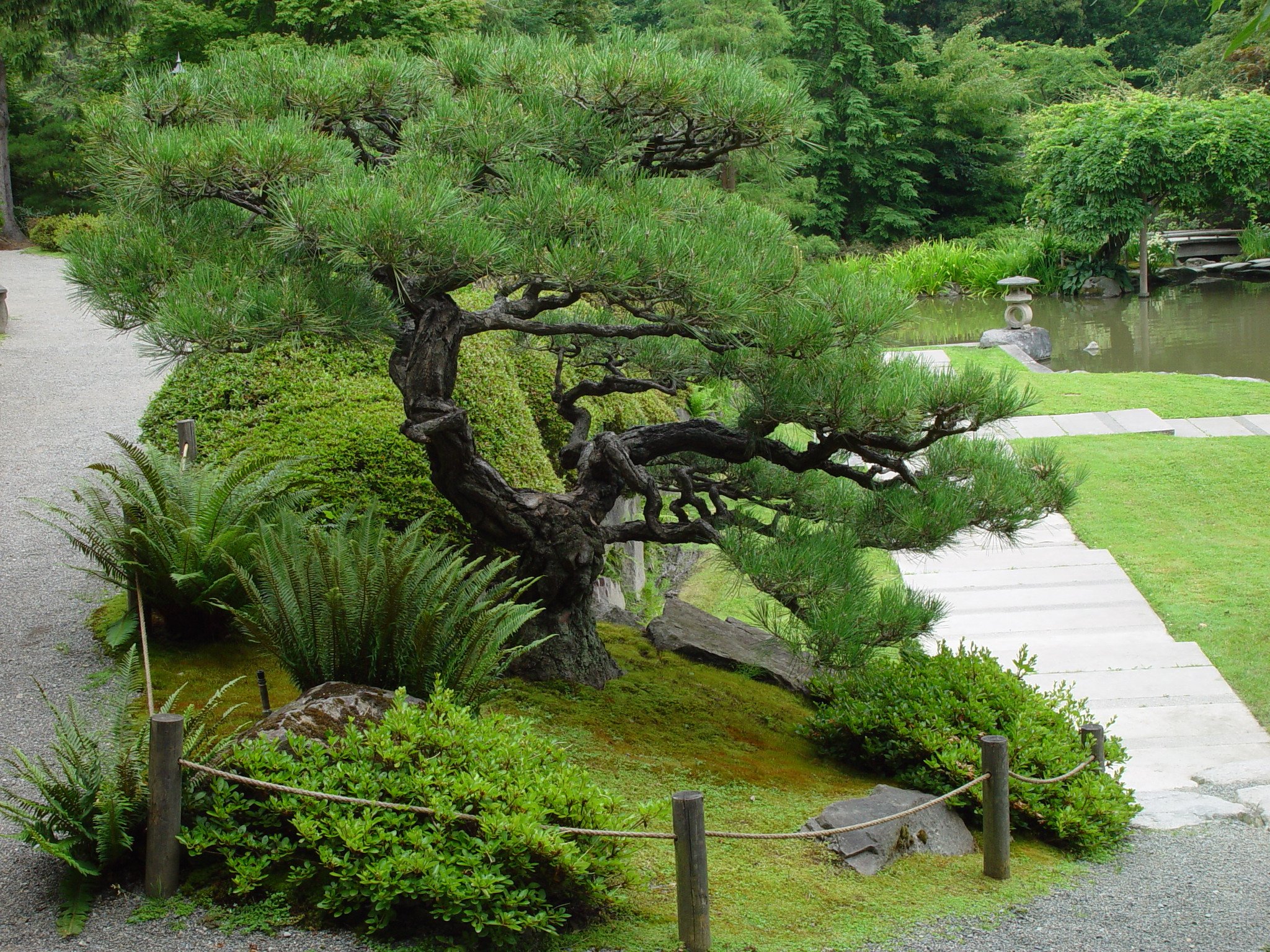
The venerable “Yamasaki pine” (Pinus thunbergii), donated by Richard Yamasaki and moved to the Seattle Japanese Garden in 1993. (photo: Seattle Parks and Recreation, 2007)
Dick was thinking about retirement by 1989, and he told SJG senior gardener Jim Thomas that he hoped the Park Department would accept the gift of his family’s Japanese black pine. A site above the northwest corner of the pond was selected, and for several years changes were made to the plantings in that area to accommodate the venerable “Yamasaki pine.” In December 1993, the Horticulture Unit of Parks hand dug the pine from Dick’s garden and replanted it in the SJG. Yamasaki’s successor, Masa Mizuno, was present to advise on the planting, assisted by Mark Akai, a long-time pruning crew member.
After retiring, Dick maintained his dedication to the Garden. Julie Coryell, garden guide and editor/translator of writings by the Garden’s Japanese creators, was introduced to Dick in 1997. She began taking notes on his memories and concerns, and in 2006 she brought Dick and Fumi to a meeting about the proposal for a new gatehouse/Japanese Garden Entry Structure. He also communicated to her his vision for a north end pavilion, included in the Garden’s original design but never built.
In 2007, Dick and Fumi left their Holly St. home and moved into a retirement facility. Dick died the following year, on February 18, 2008. [Bill had died earlier, in 1989, and Fumi died in 2017.]
Yamasaki’s Donations:
The Jūki Iida Scroll:
In 2005, Dick showed the Iida scroll to two very knowledgeable garden volunteers, who recommended that it be mounted in Japan. Extended collaboration was required to achieve this. When the mounted scroll, enclosed in a box of paulownia wood, was returned to Seattle, Dick and Fumi pronounced the scroll refined and elegant, and donated it to the Elisabeth C. Miller Library. A dedication ceremony took place on August 8, 2006. Housed in the Library’s rare book room, the Iida scroll is available for viewing by appointment.
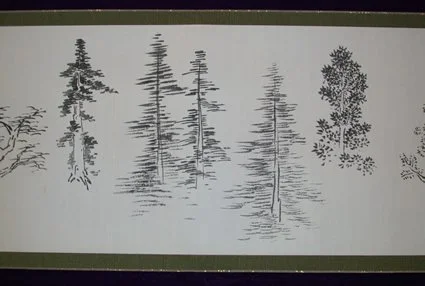
Trees, on a portion of the sumi ink scroll brushed in 1960 by Juuki Iida. (photo: Elisabeth C. Miller Library website. https://depts.washington.edu/hortlib/hours-and-contacts/history/juuki-iida-scroll/)
The Yamasaki Pine:
“The New, Old Pine in the Japanese Garden,” an article by senior gardener Jim Thomas, was published in the Washington Park Arboretum Bulletin (Spring 1994; Vol. 57 #1). Jim concludes his article as follows:
“As it adapts and grows into its place, it will serve as a living tribute to Dick Yamasaki’s generosity and devotion to our Japanese Garden over 30 years. Thank you Dick, thank you Sensei.”
The Yamasaki pine, now over 100 years old, has adapted well to the Garden, where it has remained for more than 30 years. And each year, it is lovingly maintained by candling in spring and pruning in autumn.
In 2020, the Seeing | Seeds | Stories virtual exhibition featured five artists who portrayed the Garden with stories in celebration of its 60th anniversary. Here is artist Michelle Kumata’s description of her painting of Richard Yamasaki and the Japanese black pine:
“Yamasaki carries the black pine tree and rises beyond the trials of his family’s history…. The pine represents endurance, adaptability, and a bright future. The monarch butterfly represents rebirth and transformation.”
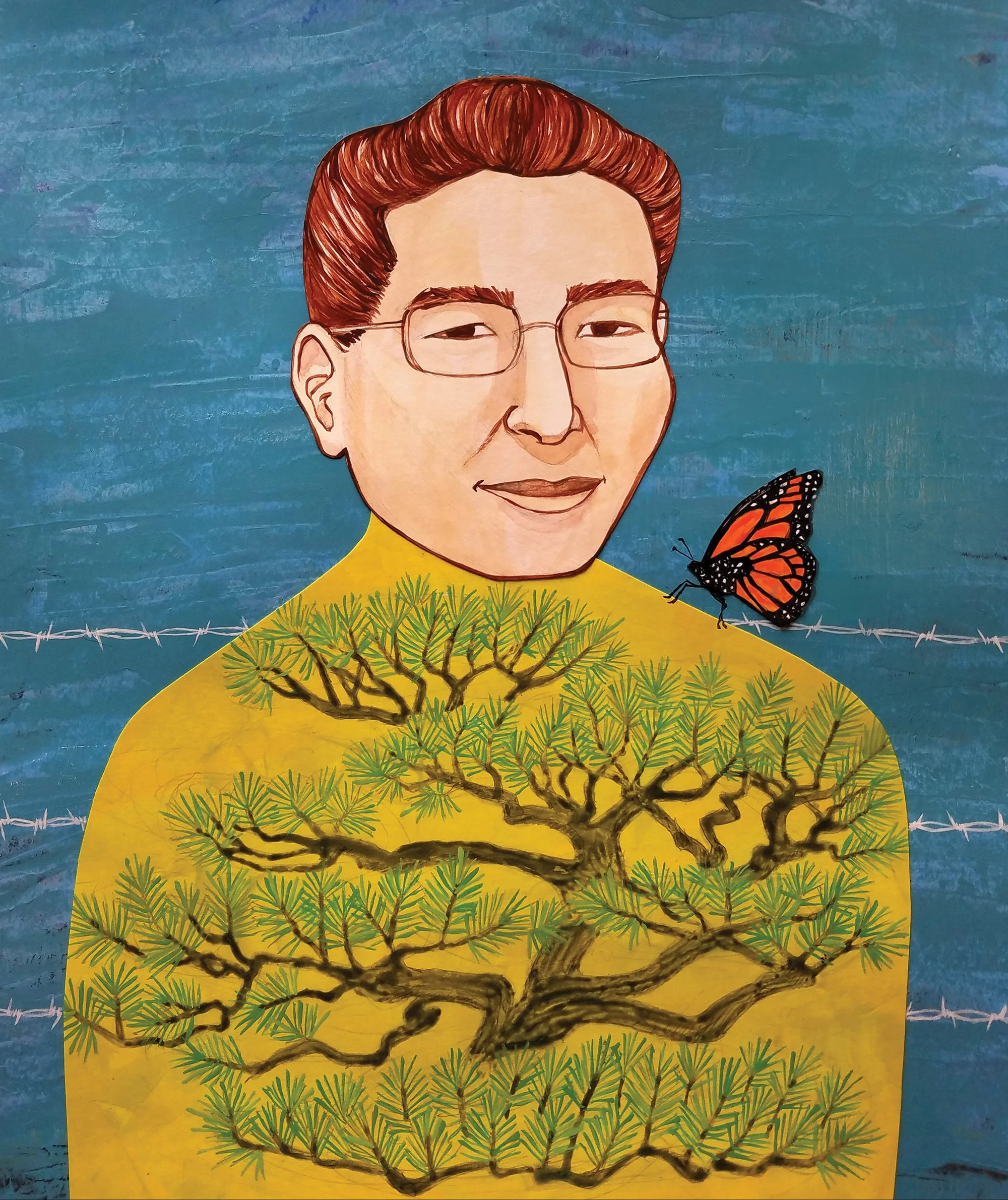
Michelle Kumata’s painting of Richard Yamasaki for the 2020 Seeing | Seeds | Stories virtual exhibition cohosted by the Elisabeth C. Miller Library and the Seattle Japanese Garden. (photo: University of Washington Magazine, “Honoring Our Roots,” December 2020. https://magazine.washington.edu/feature/artists-honor-japanese-gardens-roots/)
A Transformational Construction Project:
This summer, the Garden will close for a major construction project. As explained on the Garden’s website:
“The Seattle Japanese Garden is undergoing a rare, historic improvement project. The $2.8 million investment will replace the Garden’s deteriorating stone wall and add an accessible looped walkway so that more people—using wheelchairs, strollers, or walkers—can safely experience the beauty of the renewed shoreline.
The Garden will be closed June 22 - July 27, 2026, for demolition, and will partially reopen mid-summer for visitors to see our progress.
Upon reopening July 28, construction will enter a new phase with 15th generation master stone mason Suminori Awata leading a team of artisans from Japan and America in the laborious task of building the wall stone-by-stone. Guests are invited to visit the Garden throughout the summer months to witness this unique process as the wall takes shape.”
Senior gardener Andrea Gillespie is dedicated to preserving the beloved Yamasaki pine throughout this project. Ironically, the deteriorating rock wall was built by Richard Yamasaki and his brother Bill.
Yamasaki’s Legacy, Revealed in His Own Words:
The following quotations are from Dick’s remarks at the Iida Scroll Dedication Ceremony in 2006, recorded on the Miller Library’s website:
“Being Nisei, a second-generation Japanese born in America, I knew very little about Japanese gardens. I discussed the project with my brother and my crew and decided to accept, especially since memories of the war had subsided.
Iida would call me over, ask me to sit by him and listen to his views on what this Seattle garden would be like. Because of the language barrier, I could not ask questions in Japanese, so I just listened and watched…
There were two things that drew me to Iida sensei, and he became a mentor to me. First, he continued to help me see what he was creating, a Japanese garden in a foreign setting, but with strict application of certain Japanese principles, such as naturalness (shizensa) and the way natural elements age and spread (sono mama no susumu sugata).
Since Iida sensei’s stay was so short, he invited me to see him in Tokyo, which I did in 1967… This visit left me with deep and lasting memories and a lifelong desire to study and understand his teachings.
This is why today Fumi and I are so pleased that this scroll may now be seen by those who visit and work in the Seattle Japanese Garden. [We} have held it for so many years. It now becomes, along with his creation, and his concern for our ability to maintain the garden, Juuki Iida’s legacy to all of us.”
Yamasaki’s Legacy, Revealed in the Words of Two Senior Gardeners:
Recent oral history interviews by Rumi Tsuchihashi, WPA Major Gifts Officer, reflect Dick’s legacy from the perspective of the gardeners he trained and mentored. Here are some comments from two of them—Jim Thomas (SJG senior gardener 1989-2005) and Pete Putnicki (pruning crew member; and senior gardener from 2015-2024):
Jim Thomas learned from Dick beginning in 1980, when as the Arboretum’s senior gardener, he was encouraged to assist the SJG’s sole gardener whenever he could find some time. Soon after meeting Dick, Jim’s reaction was: “This man had the garden in his soul.” He also reports:
“When I’m asked what kept me engaged with the garden for so long, I return to the little things, like the walks. Like when Dick had me study the shadow patterns. He could help me see things I never would have noticed. I treasured those moments and shared them—with appreciative visitors and gardeners alike.”
In his oral history interview, Pete Putnicki reflects on the “lineage of intentionality”—the legacies of both Iida and Yamasaki that were passed down through succeeding generations of gardeners and consultants. Here is what he said about Dick’s influence:
“I never met Dick Yamasaki, but I learned to prune pines from him ages ago.”
“I worked in a private garden he built at a Bellevue residence in 1973… Long after [that]… I had the opportunity to prune this garden’s shore pines and big black pines.”
“That hand-to-hand part of the lineage felt as direct as any mentorship I could’ve gotten. I learned a tremendous amount from those trees, and the lessons were reinforced when, years later, I met Mark Akai, who’d learned a lot about pruning from Dick.”
Previously, in “Honoring the Design Intent,” Pete’s article in the SJG 60th Anniversary special issue of the Washington Park Arboretum Bulletin, he talks about the original vision of the Garden’s designers—their “design intent”—and emphasizes that the goal is to “creatively manage and adapt to… change in order to preserve the original vision of the designers.”
“In 1973, Iida returned to visit and helped establish a program of maintenance to bring the existing Garden closer in alignment with the original design concept. A number of large trees, ground covers and other plants were removed; a significant and painstaking pruning program was instituted…
With the vital help of gardeners and consultants such as Dick Yamasaki, Mark Akai and others, an ongoing lineage of maintenance and enhancement was initiated. Gradually, the Garden began to reflect something more than a flat implementation of the design [and]… became a true and honest fusion of ideals, images and cultures...a garden in the present tense: a place that’s living, vital and dynamic.”
In Conclusion:
The story of Richard Yamasaki’s life, his own reflections, and the words of gardeners he influenced reveal Dick’s dedicated stewardship of the Garden; his record of commitment to its maintenance, preservation and evolution; and his honoring of the vision of its designers and mentoring of its caretakers. Richard Iwao Yamasaki was truly a pivotal figure in the Garden’s “lineage of intentionality” that flows from Iida to its present-day gardeners, pruning crew members, and the official consultant who guides them.
References:
·Coryell, editor, and Prochaska, Shizue, translator. (Including 2009 translations by Keiko Minami-Page.) Rock, Water, Plant, Garden Masters’ Record: Japanese Writers on the Japanese Garden in Washington Park Arboretum, Seattle, 1959-2010, 2021. https://depts.washington.edu/hortlib/collections/RockWaterPlant_Prochaska_Coryell_2021.pdf
·Elisabeth C. Miller Library website. “Juuki Iida Scroll.” https://depts.washington.edu/hortlib/hours-and-contacts/history/juuki-iida-scroll/
·Iida, Jūki. Diary: Creating an Overseas Garden In the University of Washington May 1959 – October 1960, and July – August 1973. Coryell, Julie, editor and Prochaska, Shizue, translator. https://depts.washington.edu/hortlib/collections/Iida_Diary2021.pdf
·Kennedy, Corinne. “A Quiet Legacy: The Juki Iida Scroll,” 2017. https://www.seattlejapanesegarden.org/blog/2017/2/14/cjy4gju7a7svo3205d23wl7rfmganu
·Kennedy, Corinne. “Juki Iida and Richard Yamasaki: Collaborating in Space and Time,” 2016. https://www.seattlejapanesegarden.org/blog/2016/04/09/juki-iida-richard-yamasaki-collaborating-in-space-time
·Kobayashi, Koichi. “Welcome Rock Arrangement by Dick Yamasaki: Seattle Japanese Garden at Washington Park Arboretum,” undated. https://www.academia.edu/22385362/Welcome_Rock_by_Dick_Yamasaki
·Tsuchihashi, Rumi, interviewer. “Oral History.” A series of four blog articles posted on the Seattle Japanese Garden website, 2024. Summaries of interviews by Rumi Tsuchihashi with four senior gardens and garden consultants (Jim Thomas, Mark Akai, Masa Mizuno, and Pete Putnicki) about their work maintaining and fostering the Seattle Japanese Garden. https://www.seattlejapanesegarden.org/oral-history
·Tsuchihashi, Rumi. “The Story of the Century Old Black Pine Tree,” SJG blog article (March 15, 2015). https://www.seattlejapanesegarden.org/blog/2015/03/13/the-story-of-the-century-old-pine-tree
·Putnicki, Pete. “Honoring the Design Intent: Constant Change, Adaptive Maintenance, and the Development of the Plant Collection at the Japanese Garden.” Washington Park Arboretum Bulletin, Summer 2020. https://arboretumfoundation.org/wp-content/uploads/putnicki_honoring-the-design-intent.pdf
·Thomas, Jim. “The New, Old Pine in the Japanese Garden,” article in the Washington Park Arboretum Bulletin (Spring 1994; Vol. 57 #1).
Corinne Kennedy is a Garden Guide, frequent contributor to the Seattle Japanese Garden blog, and retired garden designer.