
Preserving History, Part Two: The Seike Japanese Garden
By Corinne Kennedy
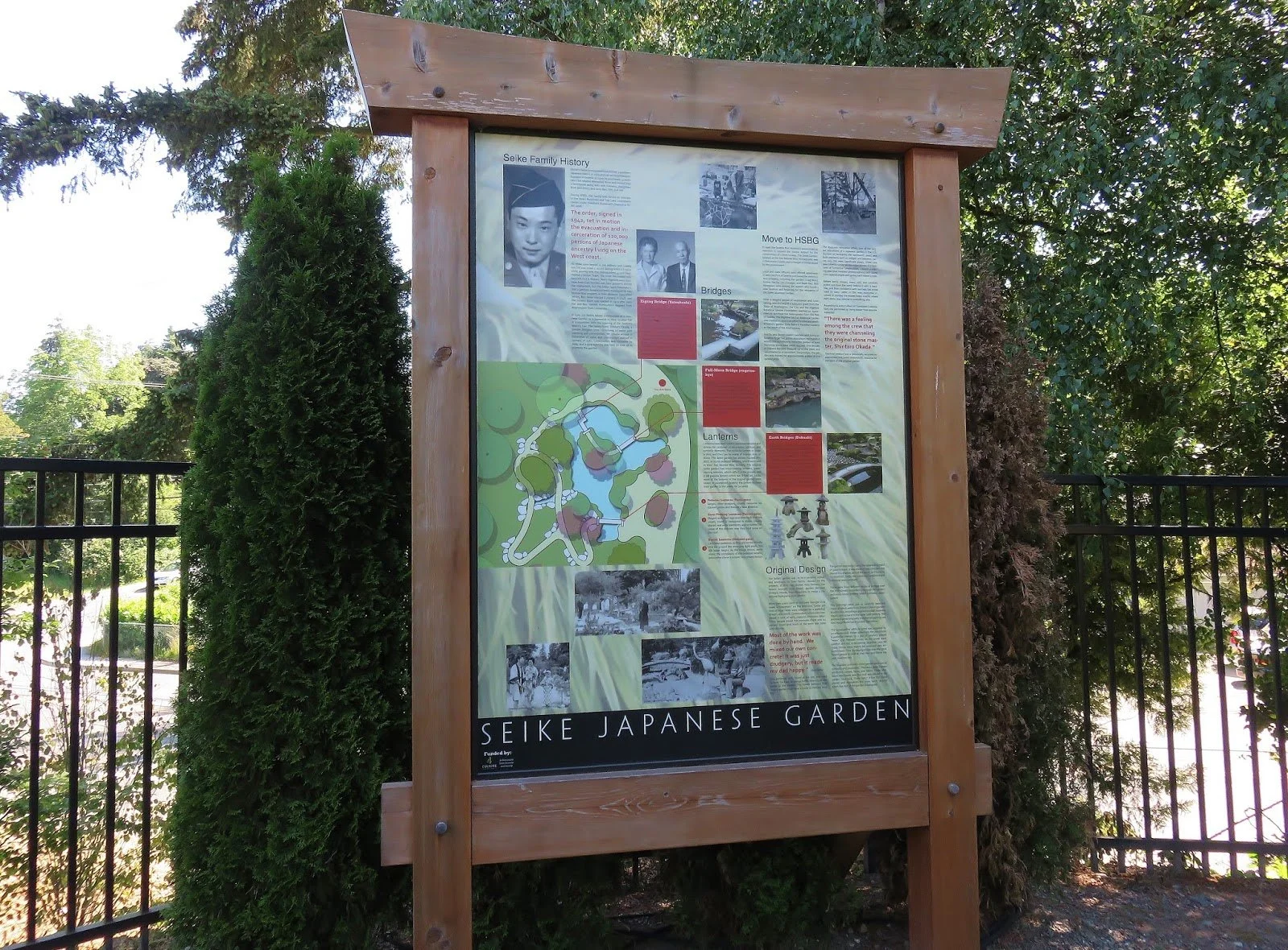
Entry sign for the Seike Japanese Garden, originally created at Des Moines Way Nursey and relocated in 2006 to the Highline SeaTac Botanical Garden. (photo: lindaletters.blogspot.com)
“This Garden was the private collection of the Seike family, a Highline family whose story of injustice, displacement and courage, can be found here. The garden is at once a beautiful place to find peace and contemplation, a faithful recreation of designer Shintaro Okada’s intent, and an historical amenity. [Highline Botanical Garden Foundation website]
This is the second in a series of blog articles about projects that preserve Japanese American history and culture. Here I profile a local Japanese-style garden with a fascinating history. It was created in 1961 by the Shinichi Seike family at their retail nursery—as a family retreat and to honor their son Toll, who was killed in action in WWII while serving in the all-Japanese 442nd Regimental Combat Team.
I remember visiting the nursery and its Japanese garden with my horticulture class in the mid-1990s. But I didn’t learn until many years later that in 2006 the Seike Garden was saved by community members and local government officials from becoming a victim of SeaTac Airport’s 3rd runway project. The family’s nursery and garden were initially purchased by the Port of Seattle, but a few years later the Garden was sold to the Highline Botanical Garden Foundation and successfully relocated to its Highline SeaTac Botanical Garden.
What follows is the Seike Garden’s compelling story:
Shinichi Seike and his family:
Shinichi Seike (c.1888-1983) immigrated to Seattle in 1919 from Ehime, a southern Japanese island, and operated a small import-export business here. Seattle Times journalist Erik Lacitis provides this summary, based on his 2017 interview with Shinichi’s youngest son, Hal:
“He owned a store on Maynard Street in the Chinatown International District, bringing in goods from Japan. He’d make regular treks in a food truck loaded with rice, soy sauce and other Asian goods to Japanese farmer camps in Eastern Washington.”
Shinichi and his wife Kameno raised a family of five children, all born in the U.S.—three sons (Ben, Toll and Hal) and two daughters (Shizu and Ruth). Eventually, in 1929, Shinichi purchased 13 acres of land near present-day SeaTac Airport, with plans to start a nursery business there.
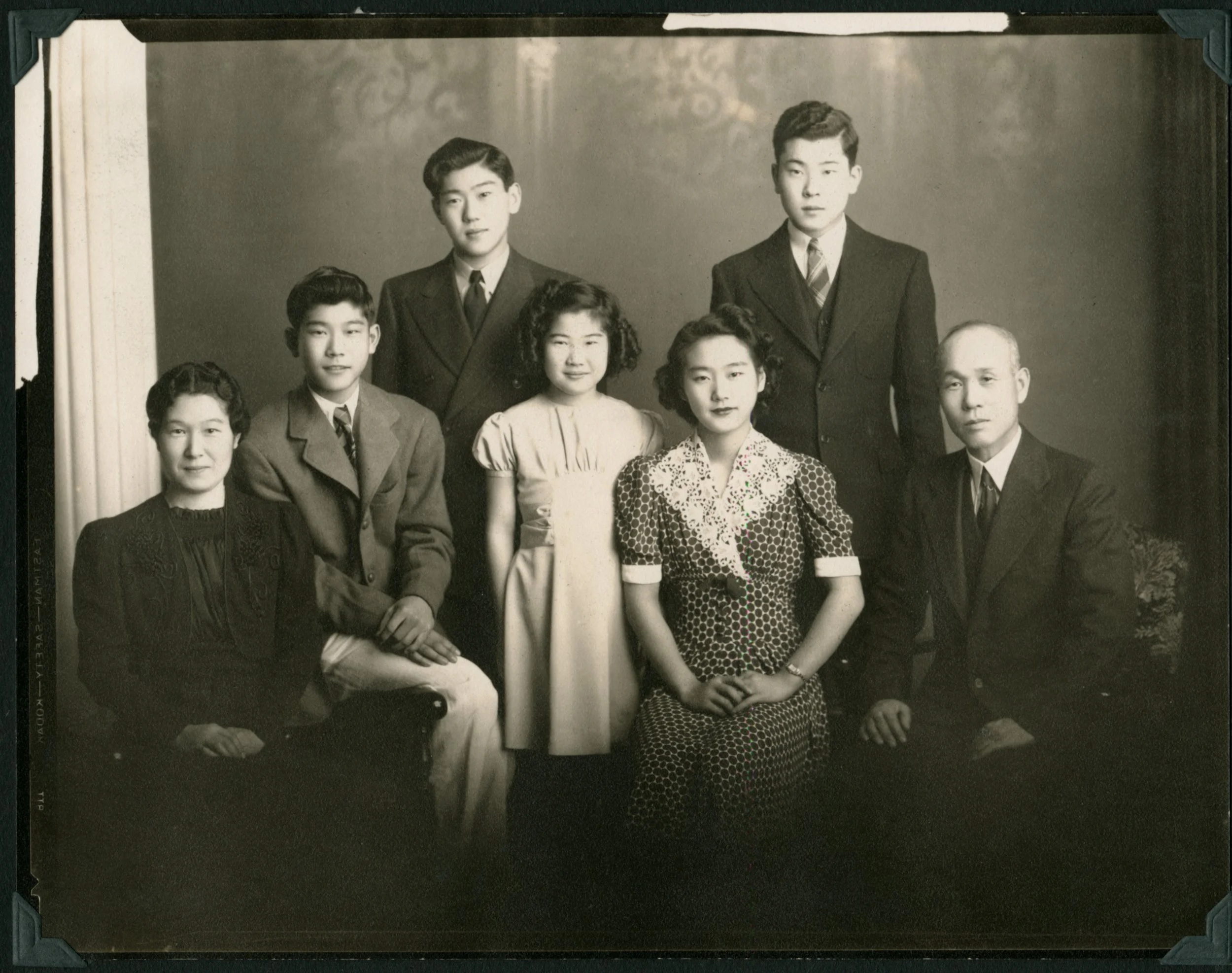
Shinichi Seike and family, c. 1940 (clockwise from top left): Ben, Toll, Shinichi, Shizu, Ruth, Hal, Kameno. (photo: Courtesy of Okano Family Collection, Densho Digital Repository)
World War II:
In February 1942, after Japan’s attack on Pearl Harbor, President Roosevelt signed Executive Order 9066, which resulted in the incarceration of approximately 120,000 people of Japanese ancestry living on the West Coast. Shinichi, Kameno, Hal, and Ruth were among those incarcerated at the Tule Lake (CA) and Heart Mountain (WY) camps.
Fortunately, the two oldest brothers, Ben and Toll, and their sister Shizu were not imprisoned. They were attending college in Eastern Washington, which was outside the “exclusion zone” from which Japanese Americans were forcibly removed. The brothers were studying at Washington State College (now WSU) and Shizue was attending college in Spokane.
In 1942, Japanese Americans were no longer allowed to serve in the military, but this policy was reversed in 1943, and eventually Toll and Ben volunteered to serve in the U.S. Army. Ben (1921-2014) served as a Military Intelligence Service interpreter in the Philippines. The youngest brother, Hal (1927-2021), served in the Army during the Korean War.
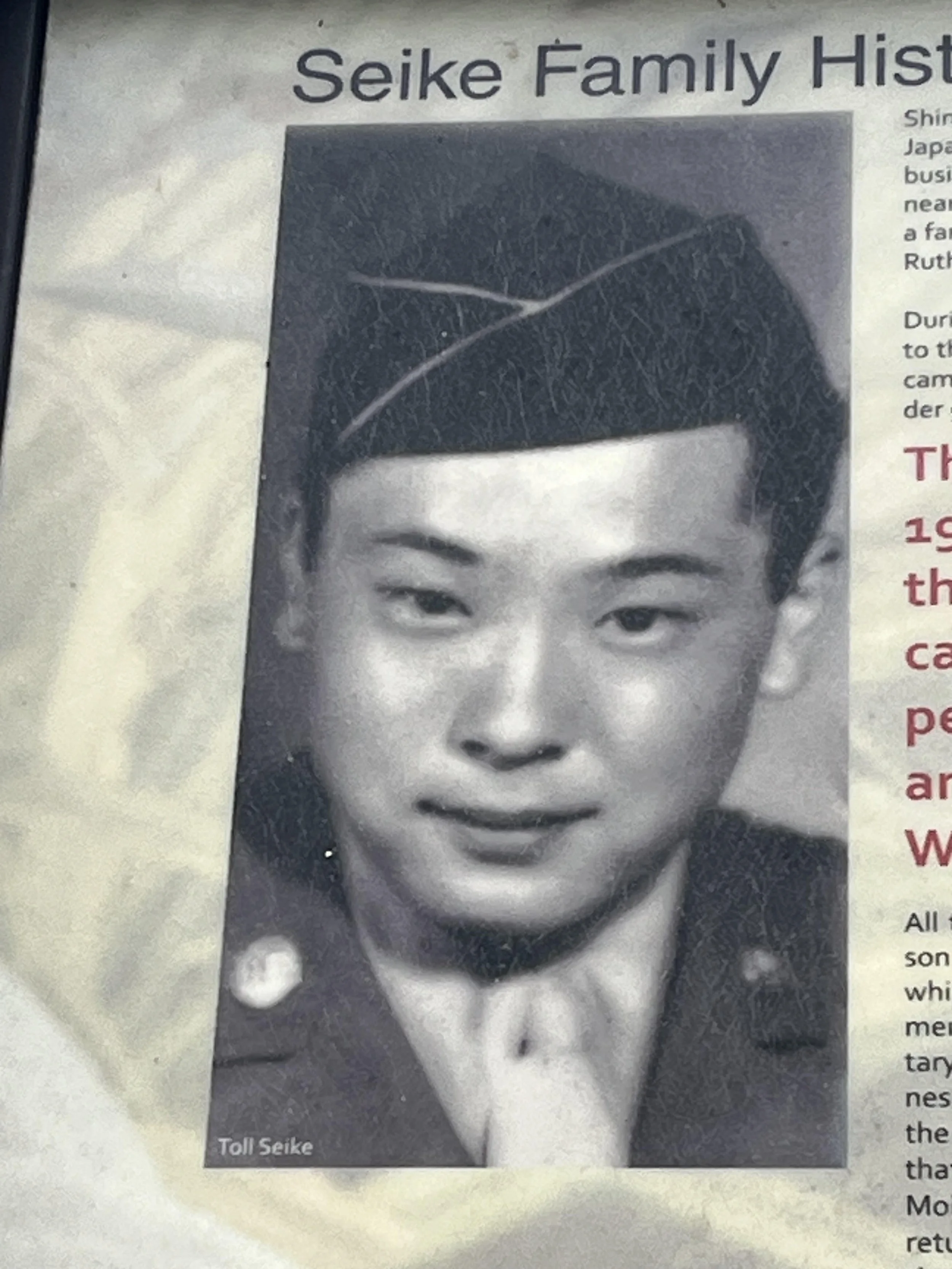
Toll Seike. (close-up photo from the entry sign at the relocated Seike Garden)
Toll (1923-1944) was killed in action in France during WWII. He was originally assigned to the 100th Infantry Battalion, which was later incorporated into the 442nd Regimental Combat Team. This renowned all-Japanese unit is widely recognized as our country’s most highly decorated military unit for its size and length of service. According to the “Fallen Cougars Homepage”:
“Private Toll Seike was killed on October 29, 1944 in one of the most famous, and costly, of the 442nd’s engagements, the rescue of the ‘Lost’ 1st Battalion” of the 141st Infantry Regiment of the Texas National Guard near the town of Bruyères in the Vosges Mountains in eastern France, near the German border. In the three-day battle, the 442nd suffered 400 casualties to rescue 230 members of the ‘Lost Battalion.’ "
After the war:
After the war, the Seike family returned to their SeaTac home. They had lost nearly everything, but unlike most West Coast Japanese American families, they did not lose their property, which had been maintained by a German American family.
Shinichi had planned for Hal and Ben to study horticulture at Washington State College (now WSU) so a nursery could be established on their property. The family succeeded in doing so in 1948, and five years later they opened a large retail nursery, Des Moines Way Nursery. Ben and Hal, having graduated from WSC with degrees in Horticulture, were its managers. Financially successful, this local landmark endured for nearly 50 years.
Building a Japanese-style garden at the nursery:
In 1961, the Seike family built a traditional Japanese-style garden, intended to serve as their personal retreat, next to the nursery. Designed by Shintaro Okada, a family friend and master garden designer from Hiroshima, it included rockwork, water (a large waterfall, stream and pond), bridges, stone lanterns, and meticulously pruned plants.
Here are Ben’s remarks in a 2006 documentary, “The Seike Garden: An American Story,” that chronicles the Garden’s history:
“[My dad’s] first thought was that the garden, itself, would enhance the nursery, and then, when the garden was almost complete, the family thought it would be a good idea to dedicate this garden as a memorial for my brother [Toll], who was killed in France in 1944.”
In a 2017 interview, his younger brother Hal explained:
“It would enhance sales of the specialized pines, maples, and stone lanterns we were selling.”
Building this traditional pond-and-mountain style garden cost about $75,000 and required arduous labor. There was no cement truck or even a small cement mixer on site. Using shovels, three people mixed the concrete by hand.
100 yards of topsoil were used to create the mountain, and about 350 tons of very large stones were needed to create the waterfall, stream, and pond. The 1500-square-foot pond held about 2,000 gallons of water, supplied by an artesian well located on the property. Water flowed from the waterfall into the stream and then the pond, which contained koi, a colorful form of carp. The Garden also contained three styles of bridges and several kinds of stone lanterns.
The following details are from the relocated Seike Garden’s large entry sign:
One particular rock, found at the site, was used to form the back of a large turtle, relaxing on the banks of the stream. The Seikes believed that "every garden must have a turtle to indicate long life.”
Many of the plants came from Shinichi’s own collection—including Japanese black pines, Japanese red pines and a very old weeping laceleaf Japanese maple.
Construction was completed in June 1961, and a gala opening was held that month. The twenty-five cent admission fee benefited Children’s Hospital, but admission was free for visitors wearing kimonos. For more than a decade, the Seike Garden was opened to the public several times a year, but increasing theft and vandalism resulted in its closure for about ten years. Reopened in 1983, the Garden endured as a place of tranquility and respite until 2002.
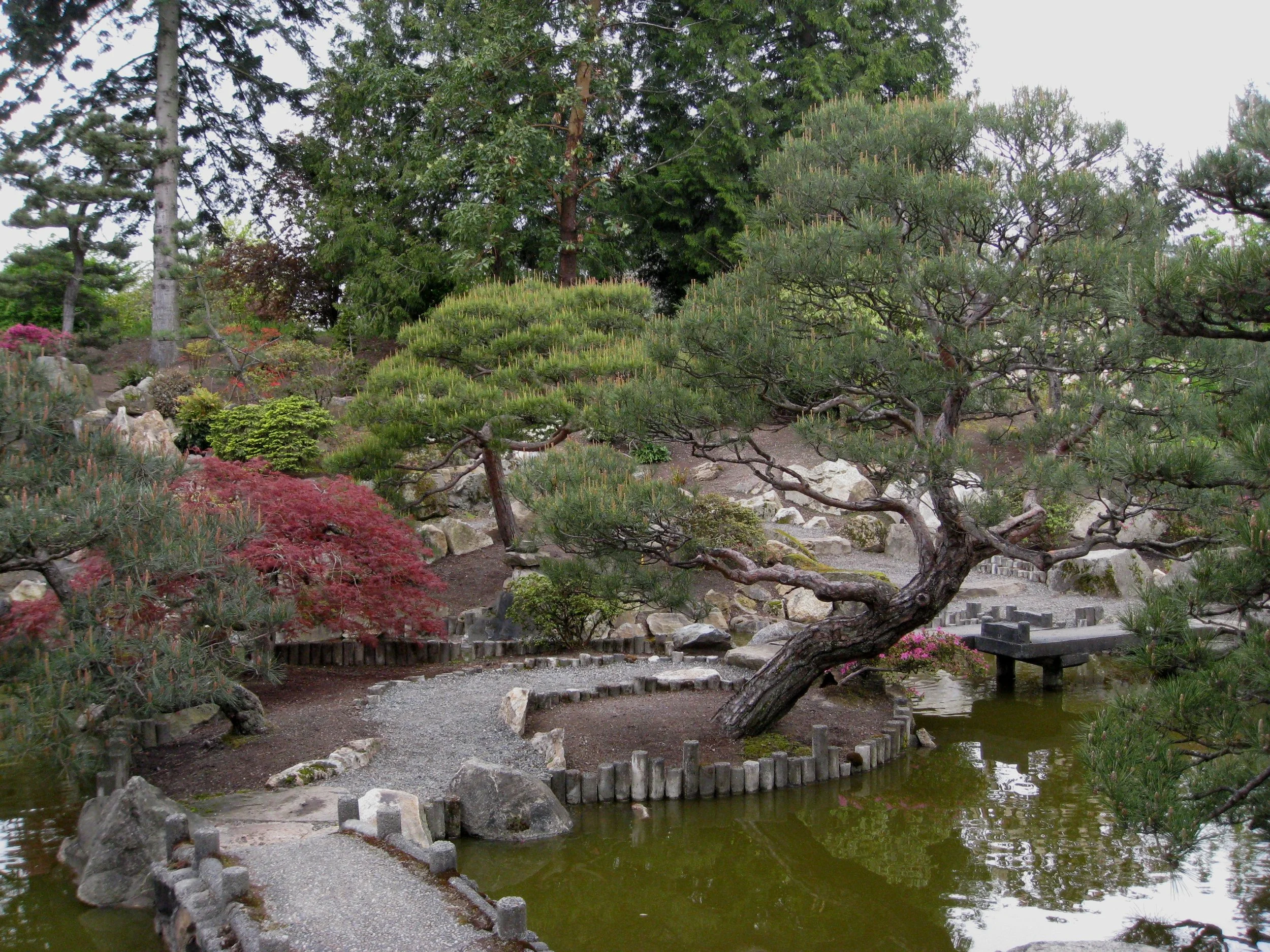
The Seike Garden, after its 2006 relocation to the Highline SeaTac Botanical Garden. (April 17, 2010 photo by brewbooks, courtesy of Wikimedia Commons)
Negotiations to save the Seike Garden:
Highline Botanical Garden was formed when two extraordinary private gardens were scheduled for demolition to make room for the flight path of SeaTac Airport’s third runway. Recognizing the cultural and recreational value of the Elda Behm Paradise Garden and the Seike Family Japanese Garden, hundreds of community members came together to find the land, funding and labor to relocate these gardens to their new home. [from the Highline Botanical Garden Foundation website]
In 2002, the Port of Seattle purchased the entire 13-acre property, including its 11,000-square-foot garden. However, if a way could not be found to relocate the Garden, the Port’s demolition contractor would have salvage rights, allowing it to sell the plants and other garden features “piece by piece.” Many of the Garden’s elements would likely be destroyed.
Negotiations and fundraising efforts resulted in funds from the City of SeaTac and a larger, $250,000 grant from the State of Washington. Craig Ward, former SeaTac city manager, and State Rep. Bob Hasegawa were among the government officials who worked to obtain financing and find a new location. Ultimately, the City of SeaTac and the Highline Botanical Garden Foundation reached an agreement to purchase the Seike Garden from the Port of Seattle.
Moving the Seike Garden to Highline SeaTac Botanical Garden:
Moving the Seike Garden was one of the largest relocations of a Japanese garden in U.S. history. Its goal was to preserve a local resource of great horticultural, cultural, and historical significance and to faithfully recreate Shintaro Okada’s original design intent. The project focused on recreating the Garden’s stonework, bridges, and lanterns. Only the most significant trees were saved, including Japanese pines and maples. Appraisers estimated that moving the Garden would cost $1 million, including $50,000 each for several large trees. In fact, the Garden was moved for about $350,000, a third of the estimated price.
The Garden’s many large stones, some weighing several tons, formed its essential structure, so their accurate placement was key to a successful relocation. Turnstone Construction, the contractor selected for this project, performed a meticulous survey and documentation of all the major stones. Their detailed moving plan involved photographing every stone from several angles and giving it a code number. Using a backhoe, each stone was carefully pulled out from the soil and an ear-tag like those used on dairy cattle attached to its back surface. As a result, those involved in moving the stones knew precisely where each stone was to be placed and its physical relationship to other stones and garden elements. Ultimately, a historically accurate reproduction was achieved, true to the spirit of the original garden.
John Fulford of Turnstone Construction reported that the job ended up being easier than anyone had expected:
"There was a feeling among the crew that they were channeling the original stone master, Shintaro Okada."
In June 2006, a Shinto Purification Ceremony was held to open the Seike Garden at Highline SeaTac Botanical Garden, about a mile from its original location.
The 2006 documentary, “The Seike Garden: An American Story,” tells the story of the Seike Garden’s creation and later relocation. It includes priceless video footage of workers building the Garden in 1961 and workers digging it up in 2006. A DVD of the documentary is available through the King County Library System (DVD-2008, DVD 712.509797).
Hal and Fran Seike’s continued involvement in the Garden:
When Hal Seike was interviewed in 2017, he was 90 years old and the sole remaining Seike brother. Hal and his wife Fran (then aged 87) were relatively healthy and still able to spend three hours every Thursday morning tending the relocated garden. As he told journalist Erik Lacitis:
“We go there rain or shine, drenched to the bone. I’ve been out there in the snow. I’m really kind of sentimental about it. That’s my family name on it.”
Fran added that her favorite garden activity was “doing the work here, the weeding and raking.” And they agreed that the Garden “is for the public, and… they should come and enjoy it.”
The Highline SeaTac Botanical Garden, owned by a nonprofit foundation, contains a total of nine specialized gardens. Volunteer labor is essential to the maintenance and survival of each one. For more than two decades, volunteers have contributed many hours of garden maintenance to this “diverse and beautiful collection of historical gardens.”
Hal Seike continued to tend the Seike Garden until his health declined. But before his death on April 12, 2021, at the age of 94, he donated a priceless gift to his family’s beloved Garden:
“His home garden held a collection of beautiful trees pruned lovingly, and with great artistry, in the Japanese style. Before his death, he gave those trees to the Highline Community for their enjoyment as part of an expanded Seike Garden. The mature trees needed special equipment to move them because of their huge and heavy root-balls, which were essential to ensure their survival. The move was expensive and this time, the Port of Seattle funded it, in recognition of the significance of the gift.” [Sarah Moore, Executive Director of the Highline Botanical Garden Foundation, in an August 2022 letter to the b-town blog]
Theft and vandalism:
Even at its original location, the Seike Garden was subject to theft and vandalism. Over the years, many of its stone lanterns were either damaged or stolen. And, as recorded in a 2010 article, this malicious destruction continued after the Garden’s relocation. Early on, the botanical garden installed a wrought iron fence and security camera to protect it.
And very recently, as reported by Sarah Moore, even the irreplaceable maples that Hal gave to the Garden were stolen—one in March 2022 and two more in July 2022. Although all parks and public gardens are subject to vandalism, we must never forget that anti-Japanese racism has not been eliminated here or within our country.
Ongoing maintenance:
Another important volunteer stepped up after reading Erik Lacitis’s 2017 article about Hal and Fran continuing to work in the Garden, despite their advancing years. James Hachiya, a Burien landscape gardener skilled in the Japanese techniques of pruning and training pine trees, began pruning the Seike Garden’s Japanese black pines and Japanese red pines.
Hachiya also emailed Lacitis, explaining how his heritage compelled him to volunteer. He had met Hal decades earlier when he bought plants from Des Moines Way Nursery and appreciated his landscaper discounts. He enjoyed talking with Hal, “gardener to gardener,” and believed that Hal trusted him to care for the Garden’s trees. Perhaps Hachiya hoped that Lacitis would continue to promote the Seike Garden and its need for volunteer labor. In fact, a 2021 Lacitis article highlighted the significance of Hachiya’s intention:
“It’s the Japanese concept of ‘On,’ roughly translating into duty or obligation… that drives me to volunteer there. I owe that ‘On’ towards them.”
In 2021, Hachiya was 62 and transitioning from installing gardens to maintaining them. At that time, he assumed that he could continue volunteering in the Seike Garden into his 70s.
Whether or not Hachiya is still pruning pines in the Garden, the reality is that gardens are always changing, maintenance work is essential for their survival, and Highline SeaTac Botanical Garden’s need for volunteers is ongoing. Here’s the link, for those who are interested in volunteering: https://highlinegarden.org/volunteer/
In Conclusion:
The following words serve as a fitting conclusion to this story. They are from Greg Butler, who was the Highline Botanical Garden Foundation’s project manager when the Seike Garden was relocated:
“On a human level, the story of the Seike family is one of remarkable determination in the face of great loss…. And on a community level, immigrant families were, and still are, the backbone of the Highline area. The story of this garden speaks eloquently of their struggles to make a life in a new, and not always accepting, land. It is my hope that the community, especially the Japanese American community, will step forward to provide the necessary means to assist the City of SeaTac with the garden’s completion and maintenance so that the remarkable story of the Seike Garden is never forgotten.”
Resources:
· Fallen Cougars Homepage. Article about Toll Seike. https://cdsc-wsu.org/ww2csp/person/toll-seike
· Highline Botanical Garden Foundation website. https://highlinegarden.org/
· Lacitis, Erik. “A Nisei garden of memories in SeaTac, and a soldier’s blood spilled in WWII (2018).” https://www.seattletimes.com/seattle-news/northwest/a-nisei-garden-of-memories-in-seatac-and-a-soldiers-blood-spilled-in-wwii/
· Lacitis, Erik. “Because of a ‘debt of gratitude,’ the Seike Japanese Garden at SeaTac lives on (2021).” https://www.seattletimes.com/seattle-news/when-he-died-at-94-hal-seikes-intricate-japanese-public-garden-in-seatac-needed-help-james-hachiya-stepped-up/
· Moore, Sarah. “Irreplaceable Japanese Trees Stolen from Seike Family Garden,” letter to the B-Town Blog (August 2022). https://b-townblog.com/letter-irreplaceable-japanese-trees-stolen-from-seike-family-garden/
· Slusher, Ken. “The Seike Garden: An American Story”, a 27-minute documentary video (2006). DVD available for checkout from King County Library System. https://kcls.bibliocommons.com/v2/record/S82C655137