
Healing Gardens Created by Japanese Americans in the WWII Incarceration Camps
By Corinne Kennedy
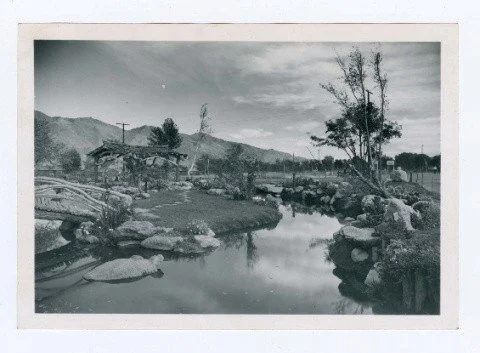
“Pool in Pleasure Park,” Manzanar, 1943. This large ornamental garden was later renamed Merritt Park. (photo: Ansel Adams, Library of Congress Prints and Photographs)
“Now, the gardens at Minidoka and Manzanar are nationally significant cultural landscapes and cultural legacies; they are symbols of immeasurable fortitude within landscapes of shame and tragedy.”
[Anna Hosticka Tamura]
In recognition of Asian American Native Hawaiian Pacific Islander (AANHPI) Heritage Month, this article focuses on a lesser-known aspect of the World War II incarceration of Japanese Americans—the gardens they created within the camps.
Two months after the December 1941 attack on Pearl Harbor, President Roosevelt issued Executive Order 9066, providing the legal authority to incarcerate the nearly 120,000 Japanese American civilians living in the “exclusion zone” (western Washington, all of Oregon and California, and southern Arizona). They were forcibly taken from their homes to ten so-called “relocation camps,” the majority located in remote, desolate areas of the Western U.S.
Most discussions of the incarceration emphasize the camps’ barbed wire fences, watchtowers with armed military police, and their crowded, unhealthy conditions. Despite the accuracy of these descriptions, they focus on the incarcerees’ victimization, without acknowledging their extraordinary agency—the courage, creativity, and resistance with which they confronted their confinement. This blog article presents a more complex and nuanced version of the incarceration story, recorded by researchers as well as camp inmates. It’s the story of the ornamental and productive gardens that they created, transforming camp landscapes and making their lives there somewhat more livable.
Racism, war, and building the incarceration camps:
Roosevelt’s Executive Order created the War Relocation Authority (WRA), which authorized the federal government to compel Japanese Americans living in the exclusion zone to sell or abandon their homes and businesses—quickly, and at a loss—and forcibly removed them to temporary assembly camps, where they lived until the main incarceration camps had been built. Most of those living in Western Washington were sent first to the Puyallup Fairgrounds (ironically labeled “Camp Harmony” by the WRA) and from there to Minidoka Camp in Hunt, Idaho. The other U.S. mainland camps were Manzanar and Tule Lake (CA), Poston and Gila River (AZ), Topaz (UT), Heart Mountain (WY), Granada/Amache (CO), and Rohwer and Jerome (AR).
Executive Order 9066 and its confinement of Japanese immigrants (Issei) and their American-born/American citizen children (Nisei) was not an isolated event, but rather the result of long-standing anti-Asian racism dating from the previous century.
The camps, quickly built and laid out like military camps, were not “instant cities.” They were prison camps, ranging in size from 7,000 to nearly 19,000 prisoners. Eight were built in the desert West—in sites as “dusty, wind-blown sites, devoid of vegetation, unbearably hot in the summer, and frigid in the winter.” [Kenneth Helphand]
Transforming camp landscapes:
Despite harsh camp conditions and their loss of liberty, the incarcerees were relentless in efforts to make their environment a more livable one. They went to work immediately, using scrap materials to build partitions and furniture for the barracks, and to create spaces for community gatherings---worship, meetings, schools, libraries, etc. They also altered the landscape, constructing playgrounds, baseball diamonds, and facilities for other sports.
Even more importantly, they transformed the desolate landscape by making gardens—a fundamental practice within their cultural heritage. In fact, many Japanese immigrants and their American-born children had previously worked as gardeners or in agriculture because systemic racism had severely restricted their work opportunities.
Throughout the ten camps, landscape development included both ornamental/beautification projects and large-scale agricultural projects. The latter, planned and administered by the WRA, provided large quantities of food to camp mess halls. Gardens, on the other hand, were created and maintained by the camp inmates.
Traditional Japanese cultural values fostered their garden making efforts: gaman (often translated as endurance, patience and/or resilience), the importance of hard work and cooperative action for the betterment of the community, and the essential role of nature and aesthetics within Japanese culture.
WRA camp administrators did not discourage the camp inmates from garden making. Three main garden types were developed: 1) Parks were the largest and most complex type, created for the use of incarcerees from throughout the camp. 2) Block or mess hall gardens were created by and for the people living within that block (most consisting of 12-14 barracks). 3) Smaller personal/dooryard gardens were individually inspired and located along a barracks building. They were sometimes referred to as “hobby gardens.”
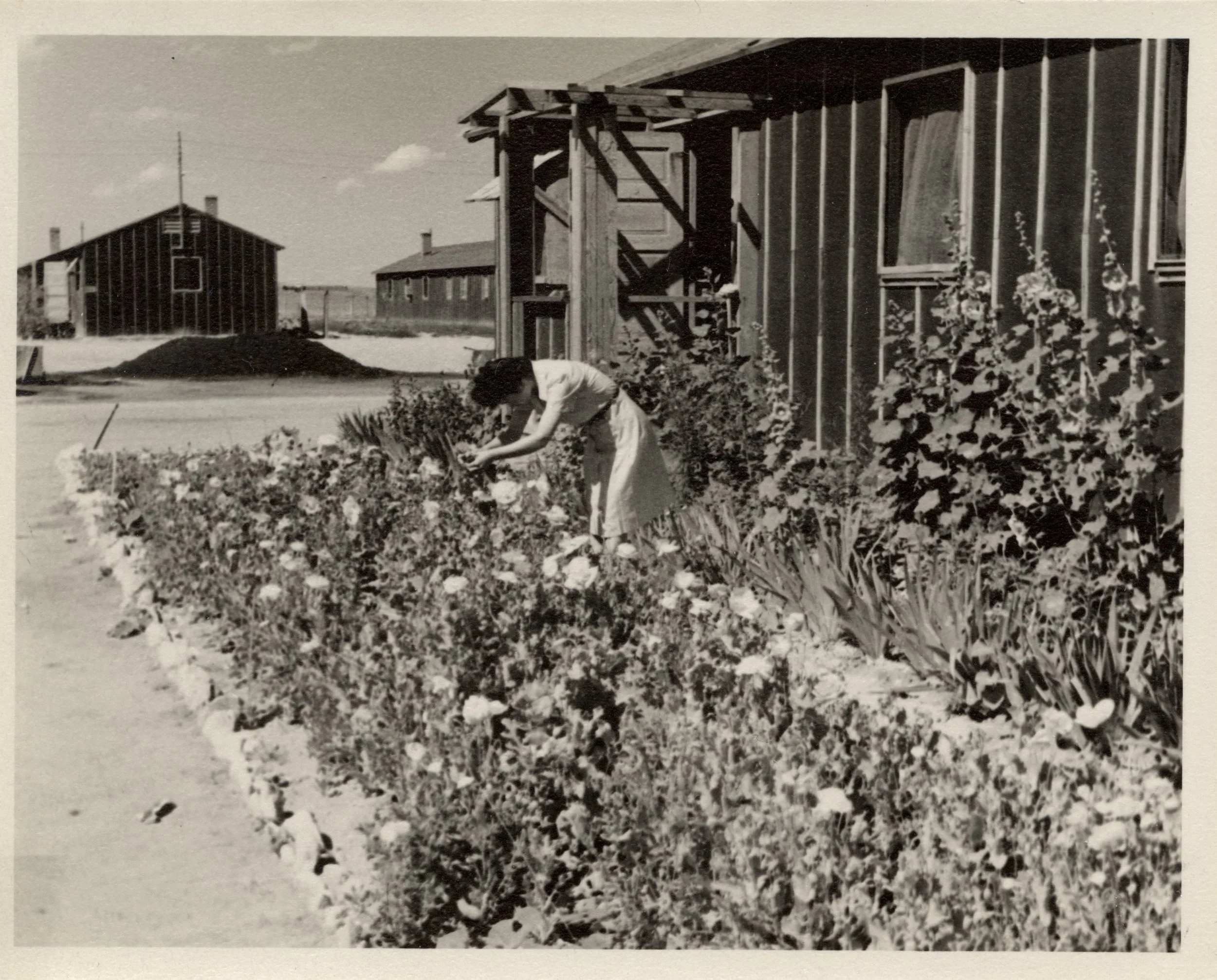
Heart Mountain dooryard/barracks garden, 7/26/1944. Written on the photo: “gardening behind barracks.” (photo: courtesy of Yoshio Okumoto)
Entry/dooryard gardens and “hobby gardens:”
Entry or dooryard gardens were traditional in Japan, and many were built in the camps. Showy flower gardens, cactus gardens, and vegetable gardens (aka “victory gardens”) displayed their creators’ gardening knowledge, skills, and pride. The latter were also cultivated in so-called “hobby gardens” located in the spaces between blocks or barracks.
Other dooryard gardens were more complex, incorporating rocks and plants gathered from outside the camp or plants propagated in camp nurseries. Some entry gardens also incorporated water features. Essential elements in traditional Japanese gardens, rocks of various sizes and ponds or other water features were often included in camp gardens, even many of the smaller ones. Found materials (items considered trash in the world outside) were often added to dooryard gardens, and included tin cans, pebbles, bottle caps, and glass. Some garden makers signed their names on concrete “tablets” next to their doorsteps.
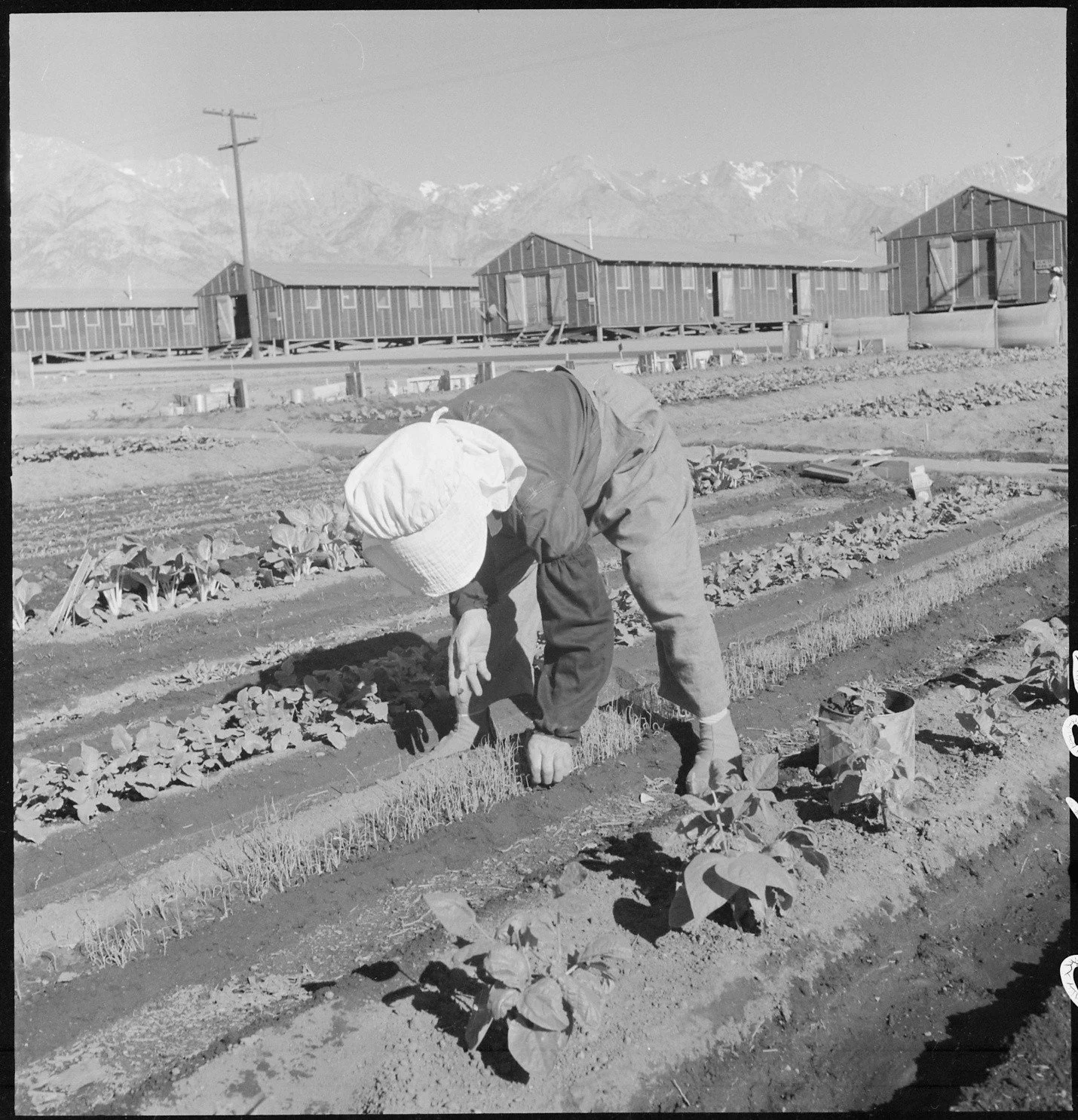
Original caption: “Manzanar Relocation Center, Manzanar, California. Evacuee in her ‘hobby garden,’ which rates highest of all the garden plots at this War Relocation Authority center. Vegetables for their own use are grown in plots 10 x 50 feet between rows of barracks.” (photo: Dorothea Lange, 7/2/1942, National Archives and Records Administration)
Mess hall gardens:
Larger and more elaborate gardens were created at block mess halls, where camp inmates waited in long lines before every meal. Large rocks, streams, and ponds were important elements, as well as trees and other plants, recreating not only the gardens of Japan, but also the Japanese American gardens they had been forced to leave behind. The beauty and cultural resonance of these gardens made the long waiting for mess hall meals more bearable.
The block 6 mess hall garden, called the “Unique Trout Shangri-La,” was the first Manzanar garden that renowned stone mason Ryozo Kado created. He also built several other gardens and Manzanar’s cemetery monument. The block 6 garden included a wooden fence, mounds, ponds, and two rocky islands as well as trees and other plants.
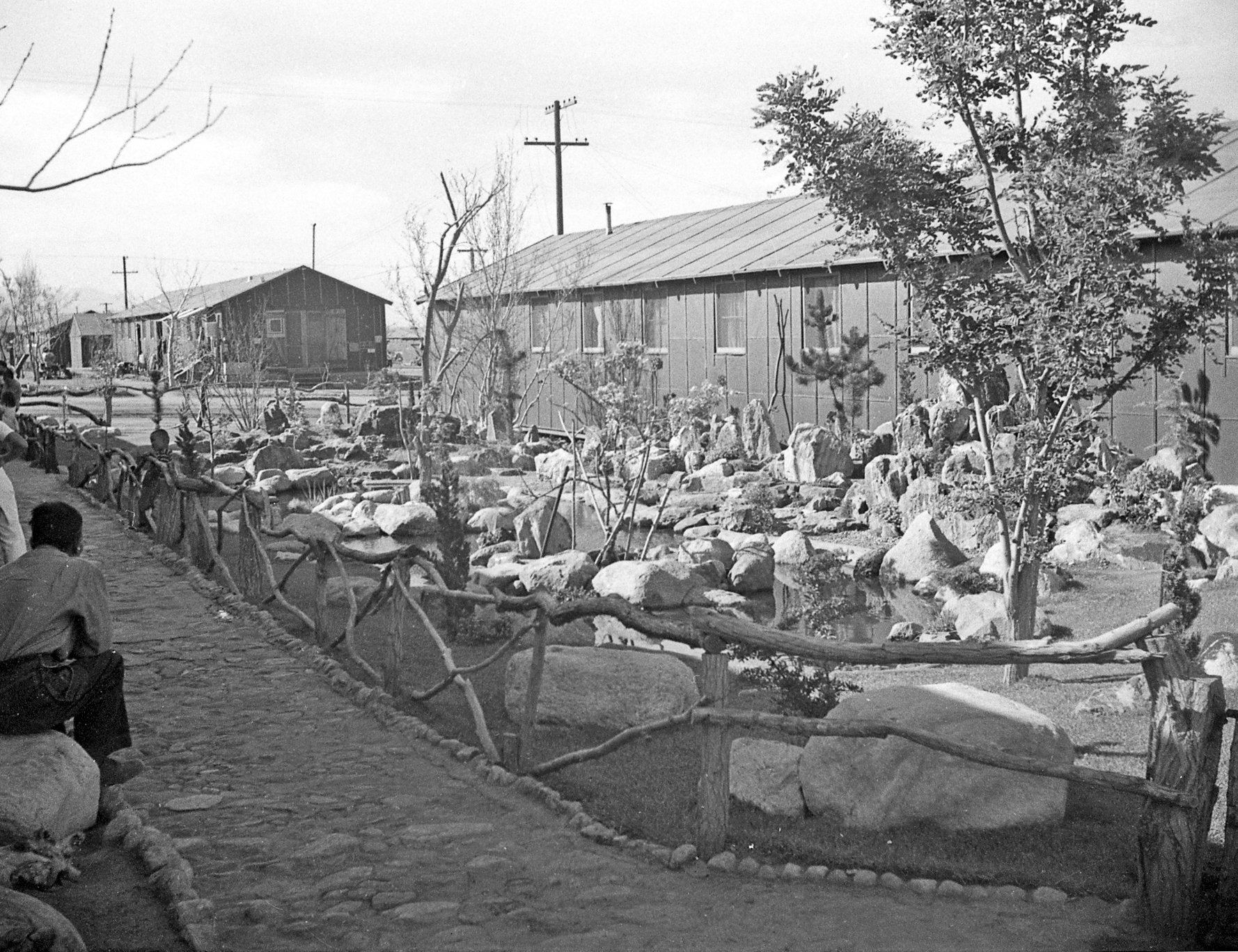
The block 6 mess hall garden at Manzanar. (photo: National Park Service, Katsumi Taniguchi Collection)
The gardens of Manzanar:
"You could face away from the barracks, look past the tiny rapids towards the darkening mountains, and for a while not be a prisoner at all. You could hang suspended in some odd, almost lovely land you could not escape from yet almost didn't want to leave."
[Jeanne Wakatsuki Houston, referring to Merritt Park; Farewell to Manzanar]
Approximately 11,000 people, including more than 400 landscape professionals, were imprisoned at Manzanar. More than 100 gardens were created there, varying in size from a few square feet to five acres. Fortunately, in comparison to gardens in the other camps, Manzanar’s gardens have been especially well documented and preserved.
The WRA’s initial objective was functional, promoting the planting of lawns to stabilize the windswept soils. At Manzanar, irrigation was not an issue because water was available from an upcountry reservoir and canals had been dug by camp inmates. In contrast, the incarcerees’ intention was to create gardens of beauty or productivity, and not simply a monoculture of grass.
Manzanar’s largest ornamental gardens were more elaborate than gardens built in the other nine WRA camps. The most ornate and important garden there was Merritt Park (previously known as Pleasure Park), which was completed in 1943. The WRA sponsored its development and paid incarceree landscape designer Kuichiro Nishi to create a design that would beautify the camp. It was built and maintained by Nishi and other camp inmates.
“Stylistically, the garden represents an early Japanese American ornamental garden with Japanese elements such as the tea house and turtle-shaped rock swimming beside the wooden bridge. In Japanese traditions, the turtle is a symbol of endurance, long life, and reflection.”
[Anna Hosticka Tamura, description of Merritt Park]
A 1943 painting of Merritt Park by artist Kitaro Uetsuzi is represented below. His painting depicts not only the rocks, pond, plants, bridge, and rustic gazebo, but also the many incarcerated Japanese Americans gathered there. [A photo of Merritt Park, taken in 1943 by renowned photographer Ansel Adams, is represented at the beginning of this blog article.]
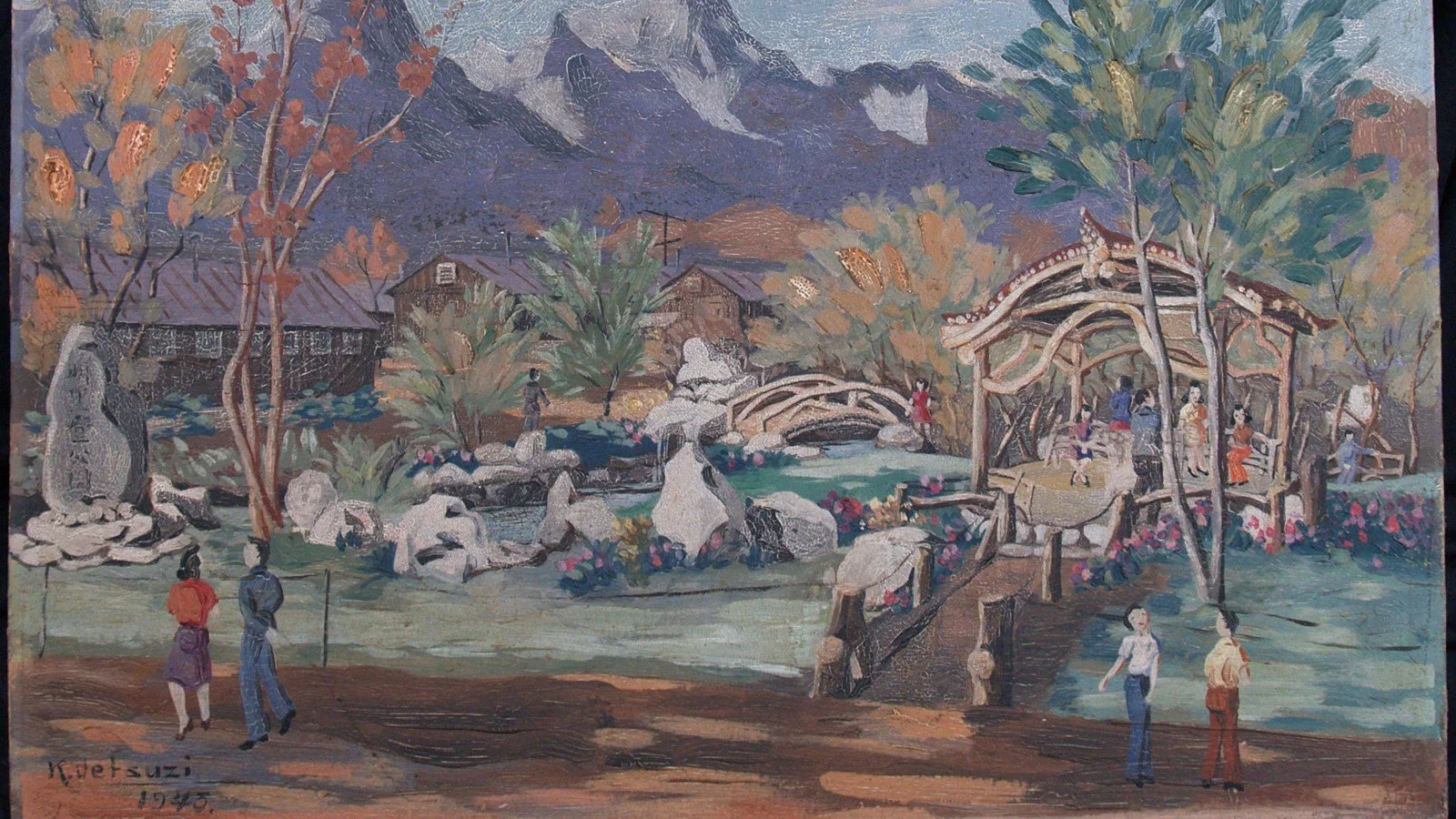
Painting of Manzanar’s Merritt Park, by Kitaro Uetsuzi, 1943. (image: from the Manzanar National Historic Site Collection)
The Photographic Record:
Fortunately, a comprehensive photographic record of Manzanar’s gardens exists. And photos of gardens in the other camps were also taken and preserved.
Several prominent photographers—Dorothea Lange, Clem Albers, and Francis Stewart—were hired by the WRA to photograph the camps. In addition, renowned photographer Ansel Adams volunteered to photograph Manzanar at the request of his friend Ralph Merritt, Manzanar’s director.
However, a photographer within the camp was needed to take family photos as mementos for young incarcerees leaving camp to serve in the army or otherwise relocate. Japanese Americans had been banned from possessing cameras, but successful commercial photographer Toyo Miyatake smuggled a lens into camp, used it to build a makeshift camera, and found a way to smuggle in film. He then persuaded Director Merritt to let him set up a photo studio within the camp. At first, a white photographer was required to snap the shutter, but when the white assistant left, a white camp employee was assigned to watch Miyatake take the photo. Eventually Director Merritt told him, “Let’s forget about anyone being with you to take pictures” and designated Miyatake as the official camp photographer. During his incarceration he produced about 1500 photographs.
“What all of the photographers had in common was a desire to show some kind of truth, and an inability to avoid restrictions from the authorities in the pursuit of that truth. What we are left with is a valuable resource to help us understand the camp experience. Although these artists were censored and manipulated, they provide for us today a concrete record of a time when American citizens were held behind barbed wire without due process of law. For that we are grateful.”
[National Park Service website]
Other incarcerees also managed to take photos within the camps, but not in the quantities taken by Lange, Albers, Stewart, Adams, and Miyatake. Gardens were only one of their subjects, but overall enough garden photos were taken to create a significant photographic record.
Gardens rich in meaning:
“The camp gardens were an antithesis to the incarceration experience and military ordered setting; they were places of adoration, symbols of strength and capacity, and testaments to a human connection to place forged out of prison-like landscapes.”
[Anna Hosticka Tamura]
As cultural, spiritual and aesthetic expressions, the incarceration camp gardens were “rich in meaning.” In “Stone Gardens: Japanese American Internment Camps, 1942-1945,” Kenneth Helphand states that “gardens provide a way to domesticate space.” This was particularly important in the camps, where the inmates were imprisoned in a bleak and hostile environment after their previous lives, homes, and communities had been violently taken away. As Helphand explains, garden making in the camps brought together elements of traditional Japanese garden culture and practice, the Japanese American gardening traditions that had developed on the West Coast before World War II, and the incarcerees’ responses to the realities of camp.
In making gardens they used their labor and creativity to take back a measure of control over their physical, psychological and social environments. With hard work, dedication, and hope for a better future they cultivated tranquility, pride in their work, and some sense of comfort or normalcy within their ruptured lives. As Helphand asserts, “The tangible physical result was a form of communication—we did this, and this is who we are.”
After the camps were closed:
When the war ended, the camps were emptied and their barracks auctioned off or demolished for lumber. No efforts were made to preserve the gardens. As time passed, they disappeared, covered over by an accumulation of sand, soil, vegetation, and camp debris.
Postwar reality was bleak for nearly everyone, even though the majority of those imprisoned were American citizens. Most were unable to recover their properties, professions, and former lives. Many never returned to their former cities or states.
But a number of those who returned to the Pacific Northwest made significant contributions to horticulture and Japanese-style gardening. They included Fujitaro Kubota, whose retail nursery became Kubota Gardens, and Richard Yamasaki, who worked under Jūki Iida in the creation of the Seattle Japanese Garden and served for many decades afterwards as a garden consultant and mentor to its senior gardeners. Both men were instrumental in designing and/or building other important gardens in the region.
Archeology and restoration:
After the war, Japanese Americans worked tirelessly to publicize the injustice of the incarceration and to fight for redress. Public opinion gradually changed, the violation of civil liberties was acknowledged, and in 1988 reparations were enacted into federal law. And as the incarceration history was revealed, the camp gardens came to be seen as nationally significant cultural landscapes meriting concerted preservation efforts. Fortunately, remnants of hundreds of these historic gardens remained. The reality, however, was that these were archeological sites, not extant gardens.
Ultimately, the National Park Service recognized that the camp sites met “all four criteria required for inclusion in the National Register of Historic Places, and many of the criteria for National Historic Landmarks.”
Manzanar’s General Management Plan and other planning documents prioritized the restoration and rehabilitation of its gardens. Many have been excavated and partially restored under the leadership and direction of Jeffery Burton, National Park Service Chief of Cultural Resources at Manzanar National Historic Site.
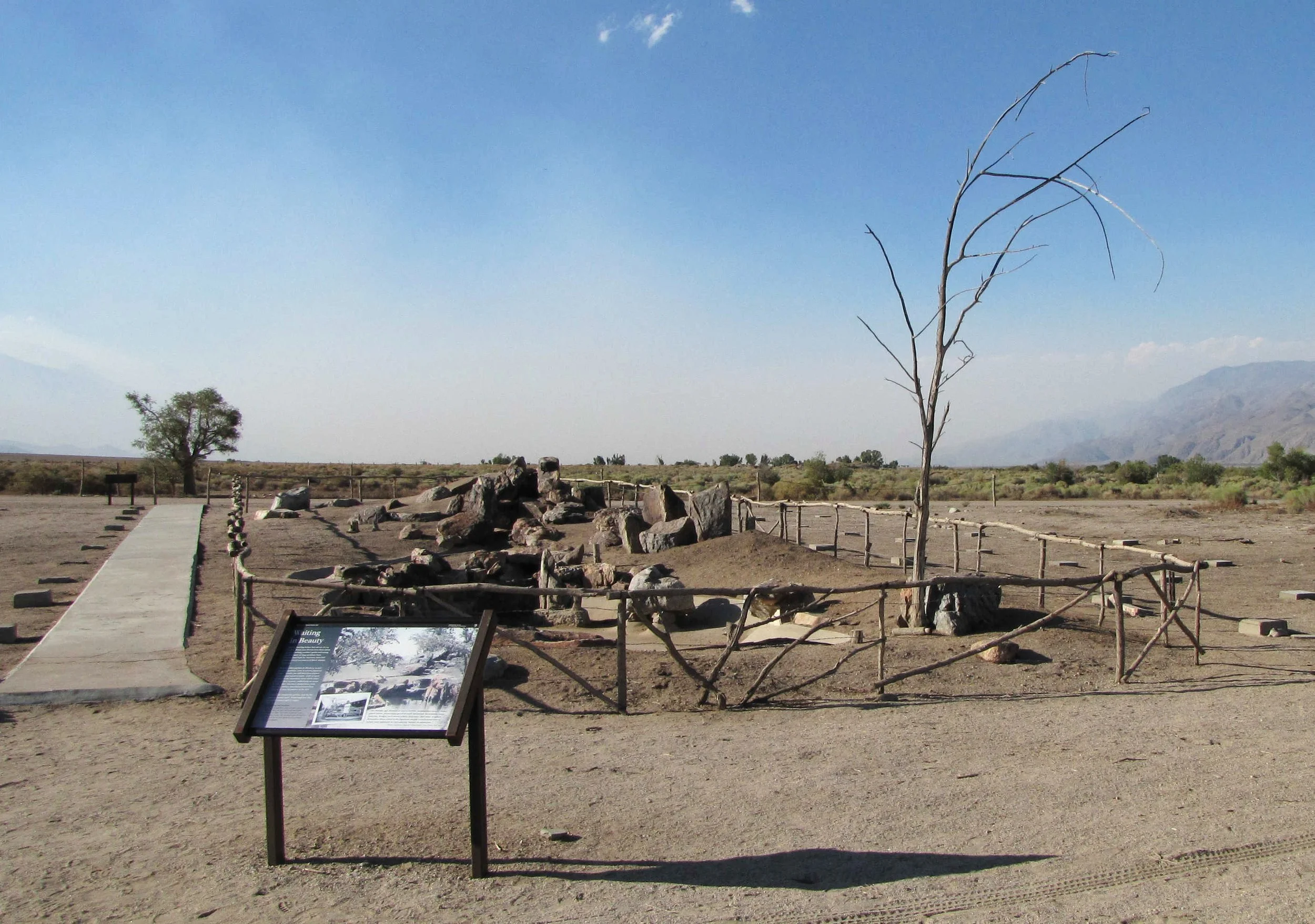
“Japanese Garden at the Manzanar National Historic Site near Lone Pine, CA, USA.” (photo: Davefoc, 9/7/2010, Creative Commons Attribution-Share Alike 3.0 Unported license)
Excavated Manzanar gardens include Merritt Park, part of the Hospital Garden, and approximately ten mess hall and barracks gardens. The objective, however, was not to create a reproduction of gardens as they existed during the war, but to reveal the essential structure created by their rocks and ponds and install signage providing the historical context.
Several other WWII Japanese American incarceration camps have also been preserved as memorial sites and museums, developed “to educate the public about the sites’ civil rights violations.” These sites include Minidoka National Historic Site (ID), Amache National Historic Site (CO), Tule Lake National Monument (CA), and Honouliuli National Historic Site (HI). Other camp sites, including Gila River (AZ) and Topaz (UT), are also viewed as meriting preservation efforts.
In conclusion:
I believe that we must never forget that incarceration in the camps brought life-long trauma into the lives of the Japanese Americans inmates and their families. Torn from their previous lives, they essentially lost everything that had been their home, including the close-knit families and Japanese American communities of the prewar era. In the camps, long-lasting conflicts emerged between those who resisted their imprisonment, answering “no-no” to the two loyalty questions the government required them to sign, and those who asserted their patriotism and loyalty, even serving in the army of the country that had so mistreated them.
Over time, diverse viewpoints about the meaning and role of camp gardens have been developed. Some authorities emphasize that garden making was above all an act of resistance to the WRA’s “Americanization regime” and frequently involved subversive/illegal activities, such as stealing bags of concrete to create garden ponds and waterways.
Other researchers who interpret camp gardens present garden making as restorative—restoring the health and self-worth of individuals and fostering communal healing. For example, camp inmates had been paid to garden for others before the war, but in the camps they gardened for themselves and their community.
Many scientific studies have shown the role of trees and “green nature” in promoting mindfulness and human health. In garden making camp inmates regained a sense of connectedness to the earth and its seasons. In their dooryard and hobby gardens, they planted seeds of familiar flowers and vegetables from their traditional diets, and they benefited from a renewed camp greenness, viewed up close or from a distance.
Of equal or greater importance, the larger ornamental gardens in the camps became places for people of all ages to walk, gather with loved ones, and celebrate milestones such as birthdays, graduations, and weddings.
Within the camp communities, garden making also empowered men and women in differing ways. When Issei men were incarcerated, their traditional authority within the family and community was lost to the younger Nisei generation, who didn’t struggle with the English language, viewed themselves as essentially American, and were favored for leadership roles by WRA authorities. But the Issei men’s prewar landscaping occupations gave them a new leadership role (and a renewed sense of self-worth), designing and maintaining the camp’s larger ornamental gardens.
Women also benefited. Before the war, ornamental garden making had been male dominated, but within the camps Issei women were active in creating and tending productive and ornamental barracks and hobby gardens. This expanded role allowed them a measure of control over their lives and environment.
Having researched the incarceration camps and their inmate-created gardens, I hope to remember always the dual reality so eloquently described by National Park Service Landscape Architect, Anna Hosticka Tamura. The experience of the Japanese American inmates was not simply one of victimization and despair, but rather a complex reality of both confinement and agency.
References:
· Born Free and Equal: The Story of Loyal Japanese Americans. Spotted Dog Press, 2002. Based on the 1944 book, with text and photos by Ansel Adams.
· Burton, Jeff and Mary Farrell. “Creating Beauty Behind Barbed Wire: Manzanar’s Japanese Gardens.” Journal of the North American Japanese Garden Association 2:50-59 (2004). https://najga.org/wp-content/uploads/2018/01/Manzanars-Japanese-Gardens.pdf
· Burton, Jeffery F. “Manzanar’s World War II Gardens Excavation, Stabilization, and Restoration.” Presentation at the North American Japanese Garden Association International Conference, Portland, Oregon September 29 – October 1, 2018. https://npshistory.com/publications/manz/esr-gardens.pdf
· Helphand, Kenneth I. “Stone Gardens: Japanese American Internment Camps, 1942-45.” In Defiant Gardens: Making Gardens in Wartime. Trinity University Press, 2006.
· Tamura, Anna Hosticka. “Gardens Below the Watchtower: Gardens and Meaning in World War II Japanese American Incarceration Camps.” Landscape Journal, March 2004. https://lj.uwpress.org/content/23/1/1
· Tamura, Anna Hosticka. “Gardens in Camp.” Densho Encyclopedia. https://encyclopedia.densho.org/Gardens_in_camp/#:~:text=Gardening%2C%20both%20ornamental%20and%20agricultural,symbols%20of%20loyalty%20and%20patriotism.