
Ryōbu: The Beauty of Bark
By Corinne Kennedy
” Unparalleled for its offering of ornament throughout the year, Clethra barbinervis (Japanese summersweet) remains, in my opinion, one of the most satisfying shrubby deciduous trees that can be grown. Adaptive to most of North America, its mottled bark in winter rivals that of the finest Stewartia. Dark green, boldly textured foliage in summer is a good foil for its racemes of highly spiced white flowers in July and August. In autumn, even in shade, the leaves turn to glowing tints of orange-red before falling.”
-- Dan Hinkley, renowned horticulturist and co-founder of Windcliff & Heronswood Nursery
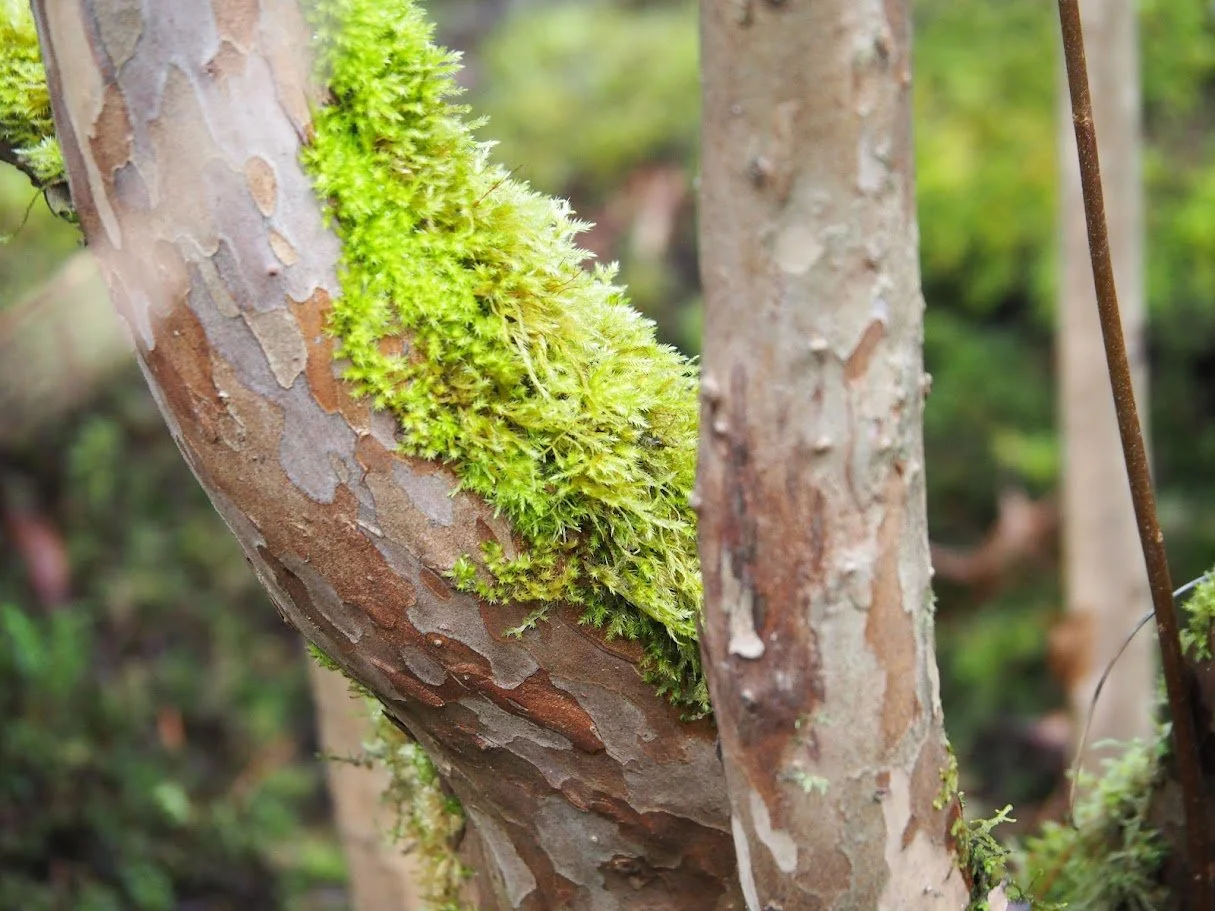
The beautiful bark of Japanese clethra in the Seattle Japanese Garden. (photo: Chie Iida, 2026)
I’ve long been fascinated by the intricacies of bark—the beautiful colors, patterns, and textures it brings to our gardens. In the Seattle Japanese Garden, I’m especially drawn to trees and shrubs with exfoliating bark—whether displayed flamboyantly, or in more subtle ways. In the words of Tanya DeMarsh Dodson, an authority on public horticulture:
“Bark can draw your eye to a tree and help you see its form… The exceptional gardener… will find enriching possibilities in extraordinary bark that can harmonize, contrast, dazzle, and surprise.”
A Favorite Small Tree in the Seattle Japanese Garden:
In the Seattle Japanese Garden, Japanese clethra (Clethra barbinervis), is a deciduous shrub or small tree with beautifully mottled bark. Known as ryōbu in Japan, it has several English common names (Japanese clethra, tree clethra, Japanese summersweet, and Japanese sweet shrub). A single plant is located near the southeastern end of the pond (in Area F). Currently more than 15 feet tall, it was likely planted many decades ago.
The Garden’s designers included ryōbu in their Plant List proposal. However, as noted by Jūki Iida and Nobumasa Kitamura, who oversaw the Garden’s 1960 creation, finding PNW sources for the Japanese plants traditionally used in Japan’s gardens was very difficult at that time.
If our specimen had been planted in the Garden’s early years, a Washington Park Arboretum (WPA) historical accession card should have been created, but unfortunately none exists. And the WPA’s important 1977 living collection record, Woody Plants in the University of Washington Arboretum Washington Park, doesn’t list this species planted within the Seattle Japanese Garden. Thus, it’s likely that the Garden’s specimen was planted after 1981, when responsibility for the Garden was transferred from the University of Washington to Seattle Parks and Recreation, and the WPA was no longer responsible for maintaining SJG accession or planting records.
The Genus Clethra and its Species:
The genus Clethra includes dozens of species (authorities generally list a number between 65 and 85, with taxonomic revisions ongoing). The family, Clethraceae, is closely related to the more well-known heath family (Ericaceae). Most species are tropical evergreen plants native to East Asia or the Americas. However, there are also several deciduous species native to more temperate regions, including Clethra barbinervis.
The genus name, Clethra, derives from klethra, the ancient Greek word for alder, indicating that the leaves of some species are shaped like alder leaves. The species name, barbinervis, derives from barba ("beard") and nervus ("nerve/vein"), a reference to small tufts of hair located along the leaf veins.
Japanese clethra in Europe, the U.S. and the WPA:
Clethra barbinervis was introduced to Europe in 1870—and to the United States in 1886, when seed was sent from Hokkaido, Japan, to Harvard University’s Arnold Arboretum.
Decades later, in 1945, the Washington Park Arboretum received seed from the Royal Botanic Gardens, Kew. Propagated from that seed and planted out in 1950, a grouping of about 10 plants still graces the Arboretum’s lower Lookout Trail. In total, there are currently more Japanese clethra plants within the WPA than of any other Clethra species.
[Plant geek note: In 1945, this accession was misidentified as Clethra monstachya. (synonym, Clethra delavayi). But in 1963 Director Brian O. Mulligan inspected the WPA plants, including their floral characteristics, and revised WPA records to indicate the correct name, Clethra barbinervis.]
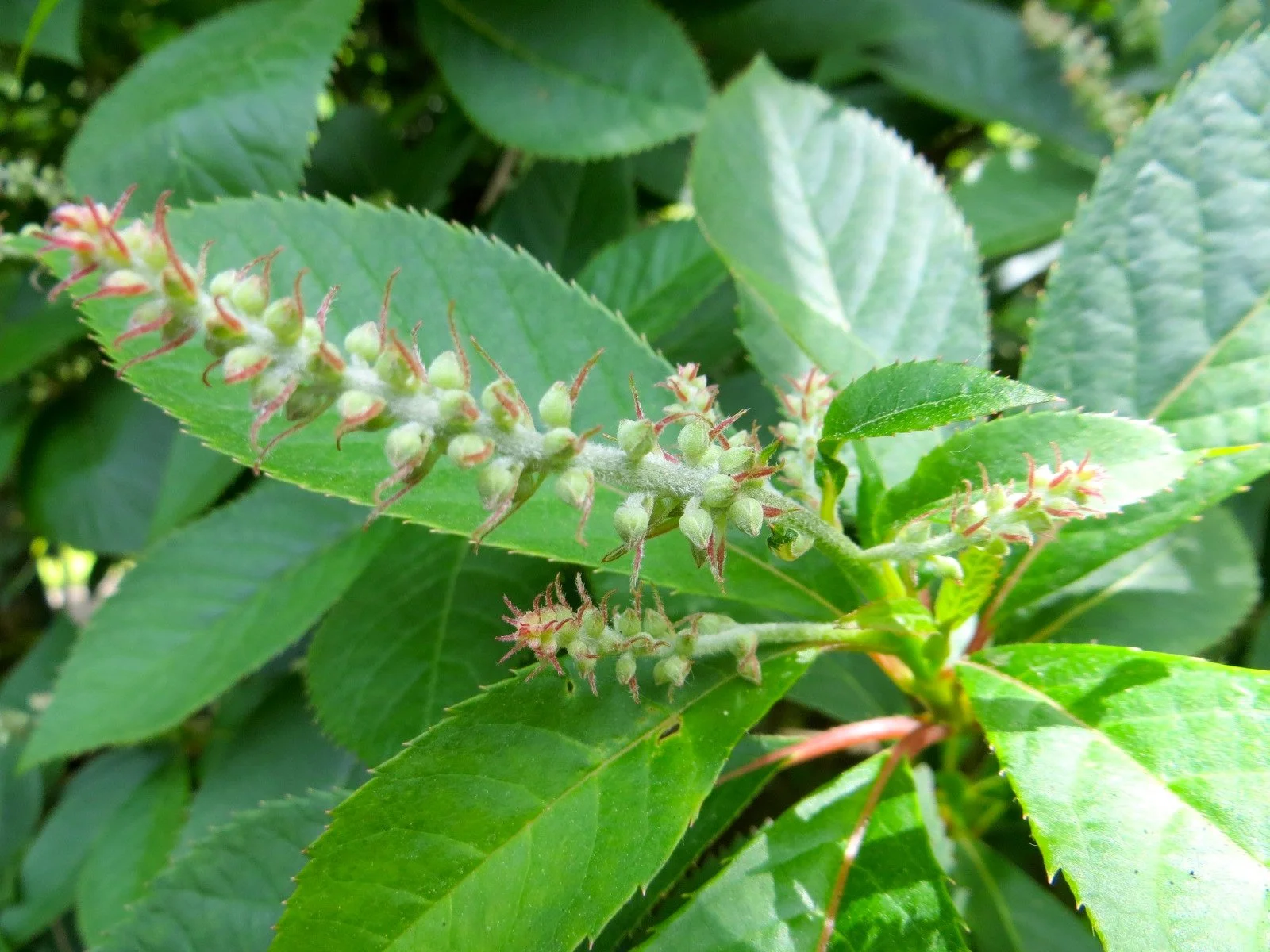
The foliage and flower buds of the Seattle Japanese Garden’s Clethra barvinervis. (photo: Aleks Monk, 2015)
Native Range and Description:
Japanese clethra is an upright deciduous shrub or small tree native to the temperate areas of Japan, the Korean Peninsula, China, and Taiwan. In its native mountain habitat, it occurs on sunny ridges and in deciduous woodlands. In Japan, it grows wild as far north as southern Hokkaido, Japan’s northernmost island. As a pioneer species that colonizes cleared woodlands, it’s often found in disturbed secondary forests.
Ryōbu is hardy to USDA Zone 5 (minimum temperature -20 degrees Fahrenheit), and grows best in light or open shade, and in soils that are consistently moist, acidic, well-drained, and organic. When planted in a location that’s too hot or dry, the leaf margins will turn brown and crispy by mid to late summer. Where drainage is adequate, it also tolerates wet soils.
Clethra barbinervis grows quickly when young and in its native range may reach 30 feet tall at maturity. When grown in our region, however, it typically matures at about 15-20 feet tall. Glossy, dark green leaves, paler underneath, are clustered at the tips of branches, creating a whorled effect. Oval-shaped, with pointed ends, and sharply toothed, they’re usually 2-4 inches long. Fall color is variable—yellow, bronze, orange, red, or sometimes negligible. Plants growing in some sun will develop the best color.
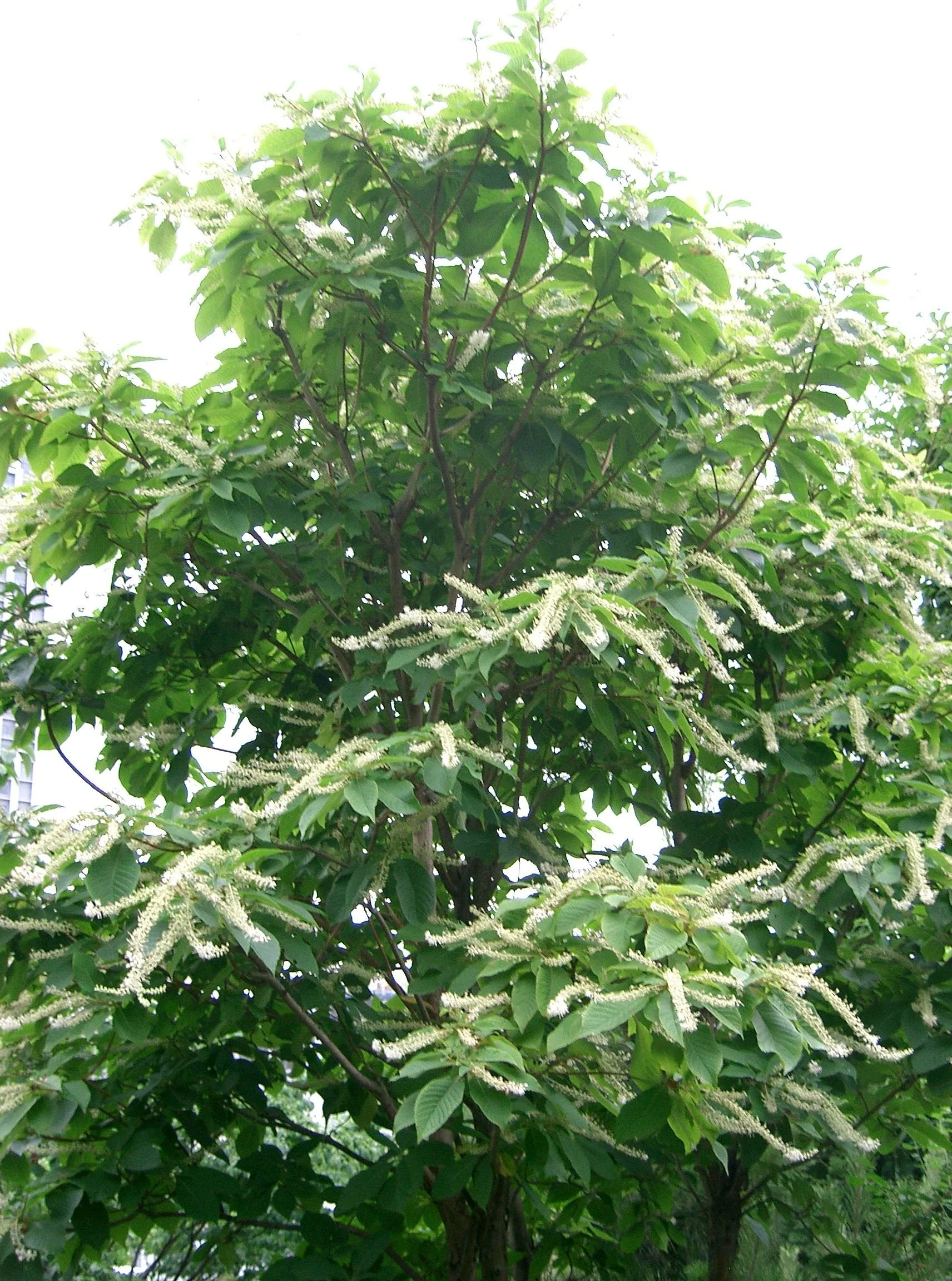
Clethra barbinervis in flower. (photo: Kenpei, 2007. Wikimedia Commons: Creative Commons Attribution- ShareAlike 2.1 Japan license)
Small, white, fragrant flowers are held in 4-6-inch-long drooping racemes (many small flowers on slender stalks) at the tips of branches. Their nectar is very attractive to bees and butterflies. In the Pacific Northwest, the flowers usually begin opening in July. Fruits are formed in autumn—spikes of dry, brown seed capsules that persist into winter.
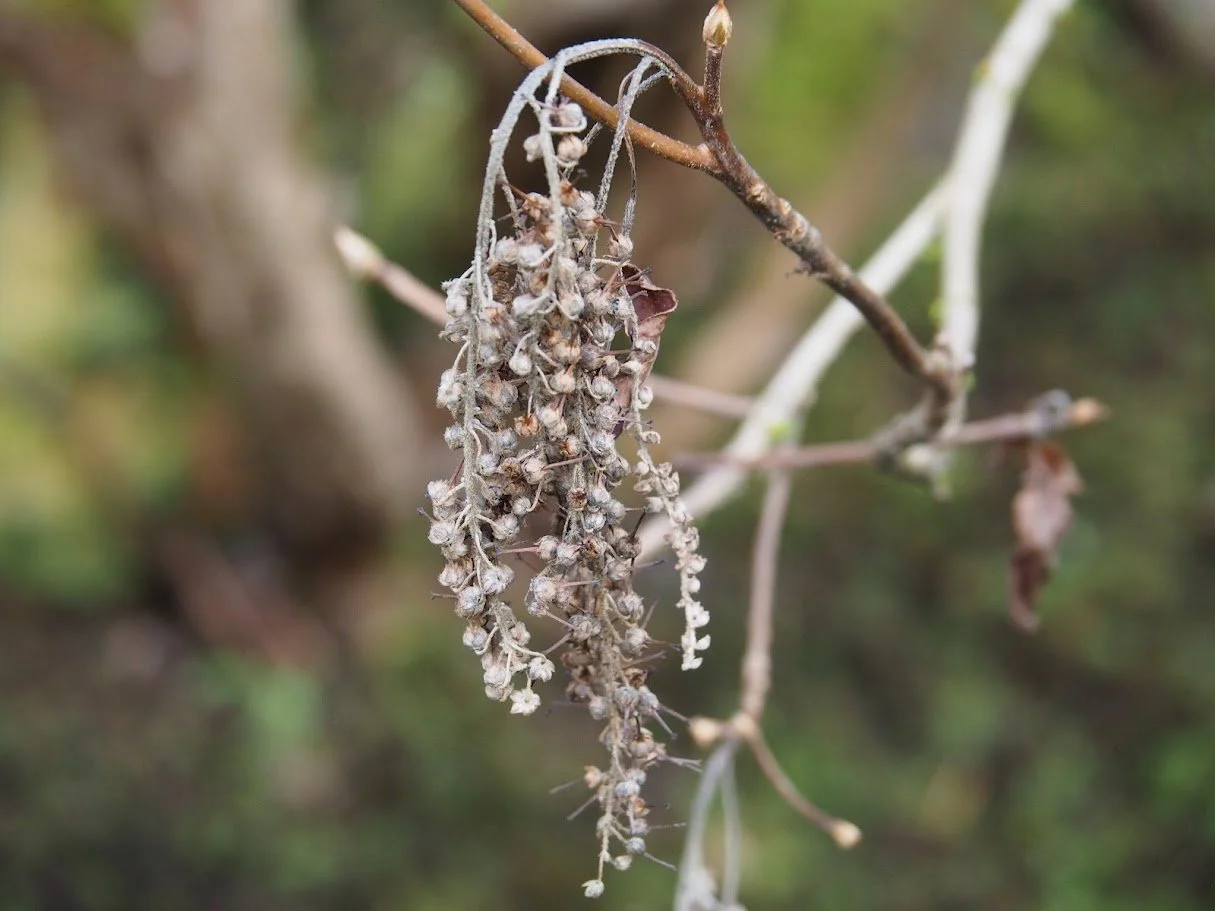
Ryōbu displays persistent dry seed capsules that remain attractive throughout winter. (photo: Chie Iida, SJG 2026)
Exfoliating Bark:
The most spectacular aspect of Japanese clethra is its smooth, polished, peeling bark, often a blend of cinnamon, brown, and gray, which develops as plants mature. Bark adds color and texture to the landscape throughout the growing season and continues to provide interest during the darkest months of winter. I believe that attractive bark should be viewed as one of the plant characteristics most valued in Japanese-style gardens—along with leaf colors and shapes, plant growth habits (natural and achieved by pruning), the transient beauty of flowers, and nature’s many shades of green.
Unfortunately, seed-grown ryōbu plants exhibit considerable variation in bark color and degree of exfoliation. The Seattle Japanese Garden’s plant has exquisitely mottled bark, resembling that of this species’ finest specimens.
Traditional Uses in Japan:
In Japan, the primary importance of Clethra barbinervis has been as an ornamental plant in parks and gardens, valued for its graceful woodland form and attractiveness in all seasons. It is also sometimes used in bonsai.
The hard, dense, wood of ryōbu has been used for making charcoal, and in construction and tool making. Branches with attractive bark were used as alcove-posts (tokobashira) in traditional Japanese buildings.
The young, tender leaves and shoots, harvested in spring, can be eaten raw but traditionally have been prepared by boiling (to reduce bitterness) and drying (for preservation and storage). Historically, they’ve served as one of the wild-growing famine relief foods eaten during severe food shortages, notably in the Edo period (1603–1868), when abnormally cold weather, drought, and volcanic eruptions resulted in cataclysmic death tolls.
The young spring leaves are generally considered safe and nutritious and are still eaten in some regions of Japan as wild “mountain vegetables” (sansai). However, research has shown that plants can accumulate heavy metals, including Nickel (Ni), from some soils.
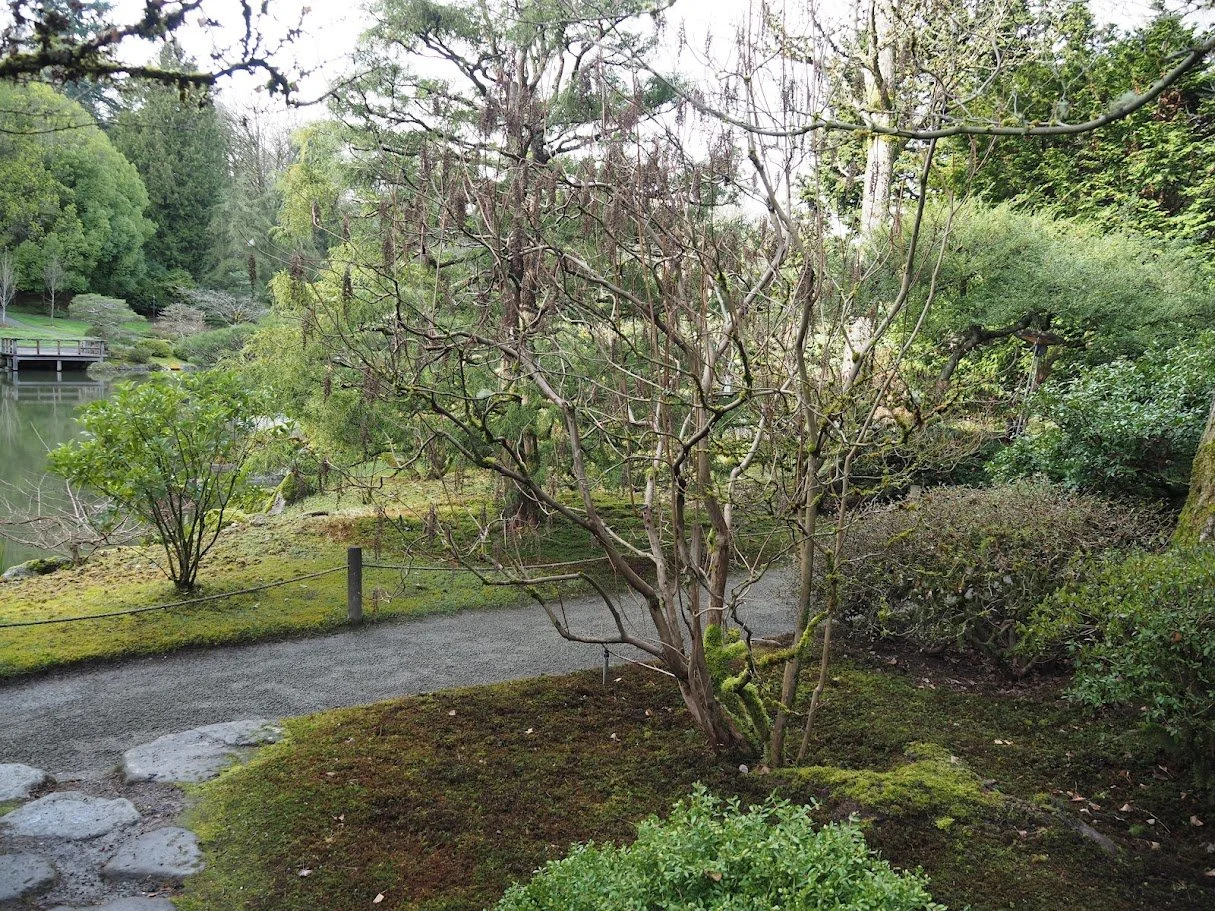
The beautiful bark and sinuous branching of the Garden’s Clethra barbinervis. (photo: Chie Iida, 2026)
A Wonderful Plant for our Gardens:
Clethra barbinervis is an excellent, trouble-free shrub or small tree, with no serious insect or disease problems. With its graceful form and attractive foliage, summer flowers, fall color, and bark, it’s an excellent multi-season plant for shrub borders or open woodland gardens—planted as a single specimen or in a small grouping. It also works well when planted in moist areas along streams or ponds.
To highlight its beautiful bark and persistent seed spikes, plant Japanese clethra where it’s easily seen throughout the winter. Keep in mind, however, that it’s not drought-tolerant, and requires rich, well-drained soil and shade from the hot afternoon sun. It does require regular watering, but otherwise it’s adaptable and tough enough to meet the challenges of climate change in our region.
Though still rare in the U.S., ryōbu is a graceful, four-season small tree or shrub deserving of a much larger role in our gardens. Fortunately, it’s available for purchase from some mail-order and retail nurseries.
References:
· DeMarsh-Dodson, Tanya. “Enriching Your Garden with Tree Bark.” Pacific Horticulture. https://pacifichorticulture.org/articles/enriching-your-garden-with-tree-bark/
· Dunne, Niall. “Japanese Sweet Shrub: Clethra barbinervis.” Washington Park Arboretum Bulletin, vol. 81, no. 2 (Summer 2019), 17-18. https://www.arboretumfoundation.org/wp-content/uploads/2019/07/dunne_clethra-barbinervis.pdf
· Hinkley, Dan. “Expert Plant Picks for Your Fall Garden.” Garden Design. https://www.gardendesign.com/plants/fall-color.html
· Levy-Yamamori and Gerard Taaffe. Garden Plants of Japan. Timber Press, 2004.
· Osawa, Yoshimi. “Ethnobotanical review of traditional use of wild food plants in Japan.” PubMed: National Center for Biotechnology Information, National Library of Medicine (NIH), 2024. https://pubmed.ncbi.nlm.nih.gov/39574124/
[This is an in-depth revision of a short article originally published in July, 2015.]
Corinne Kennedy is a Garden Guide, frequent contributor to the Seattle Japanese Garden blog, and retired garden designer.