
Preserving History, Part One: Maui’s Nisei Veterans Memorial Center (NVMC)
“Every program, exhibit and event presented at the center is in keeping with the NVMC mission of igniting human potential by inspiring people to find the hero in themselves through the legacy of the Nisei Veterans.”
[from the NVMC’s Okage Sama De newsletter, Spring 2023]
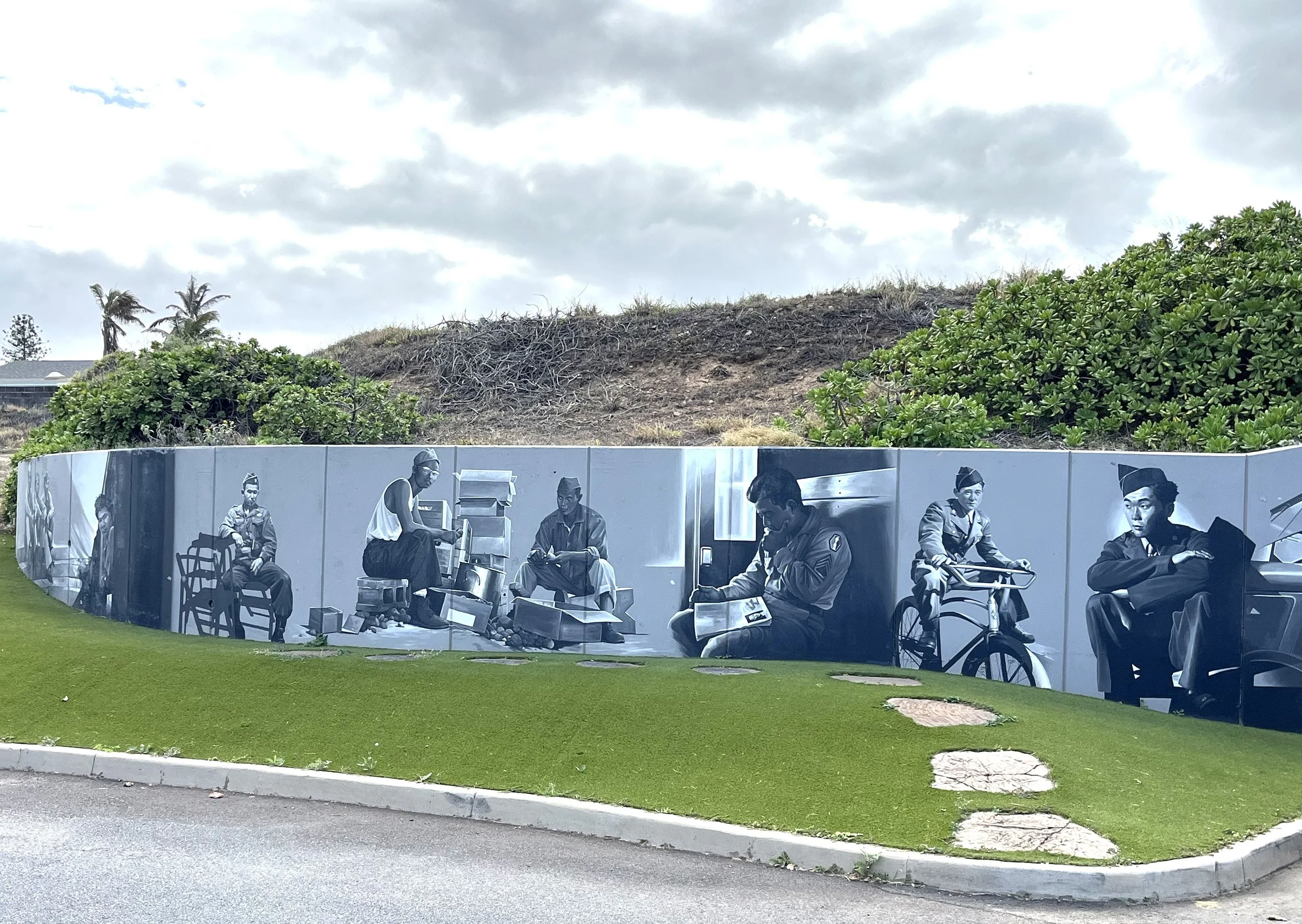
Renowned Maui portrait artist Kirk Kurokawa completed the NVMC’s monumental twelve-scene mural in 2019. It was given the name “Quiet Dignity, Everlasting Honor.” (photo: Corinne Kennedy)
As a Seattle Japanese Garden docent, I’m passionate about projects that preserve Japanese American culture and history—including Japanese-style gardens and other historical sites, museums, physical books, oral histories, and physical and digital archives. Some local organizations, such as the online archive Densho (https://densho.org/about-densho/), are relatively well-known. But other lesser-known organizations are also doing important work to preserve that history.
This article is the first in an occasional series focusing on historical preservation projects—not only in the greater Seattle area and Washington state, but also in Oregon, California, and Hawai’i.
Introducing the Nisei Veterans Memorial Center, Maui:
When planning a recent trip to Maui, I learned about the Nisei Veterans Memorial Center (NVMC), located in Kahului, not far from Maui’s main airport, and eagerly made plans to visit it. NVMC owns and manages an intergenerational campus that includes a preschool, an adult day care center, and an Education Center with extensive archives. It was created to preserve and interpret the history of Maui’s Nisei (second generation Japanese American) veterans who served heroically during World War II—notably in the Army’s 100th Infantry Battalion, 442nd Regimental Compact Team (RCT), and Military Intelligence Service (MIS).
Decades of History:
In 1982, Leonard Oka founded Maui’s Sons and Daughters of the 442nd, the first of many “sons and daughters of the 442nd “ organizations later created in Hawai’i and on the U.S. mainland. His father, Clarence “Hekka” Oka, had served in the 442nd, and the new organization was dedicated to preserving the history and legacy of Maui’s 442nd veterans. Later, after Oka gained support from six other Japanese American veterans associations on Maui, it was renamed Maui Sons and Daughters of the Nisei Veterans, reflecting its more inclusive focus.
The group’s original objective was to create an archive of materials—including oral histories, documents, photographs, and artifacts—from Nisei veterans and their families. Over time their expanded intention was to create the NVMC campus, a “living memorial” to the soldiers’ loyalty, sacrifice, endurance, and resilience that would inspire current and future generations “to find the hero in themselves through the legacy of the Nisei Veterans.” More broadly, their vision was to nurture “a community where all people act selflessly for the greater good.”
A site was secured in 1987, when the Alexander and Baldwin company gifted two acres of land to the Maui Sons and Daughters of the 442nd (later transferred to the NVMC). But without the dedication and hard work of the Maui Sons and Daughters of the Nisei Veterans—over several decades of planning, fundraising, and construction—this vision would not have been realized. The NVMC was incorporated as a non-profit in 1991, and in 2006 its first building was completed.
Today, the Nisei Veterans Memorial Center is a unique inter-generational facility. Individual agencies—the Maui Adult Day Care Center’s Oceanview Branch and the Kansha Pre-School—are tenants that ensure the center’s economic stability as well as anchoring it within the larger community. Planned activities ensure that preschoolers and seniors engage with each other every day.
The Leonard Oka Education Center was completed in 2013, and in 2022 the Stanley Izumigawa Resource Center was dedicated, making possible an increase in visitors, research opportunities, and educational and community events.
The Center’s Monumental Mural:
In 2019, a bare concrete retaining wall above the NVMC’s entry driveway became the canvas for a monumental twelve-scene mural. Renowned Maui portrait artist Kirk Kurokawa began painting in March 2019 after more than a year of research in the center’s archives, absorbing the stories of the veterans that his mural would memorialize. Working from photos in the archives, and using ordinary exterior house paint, he painted outdoors for six months, featuring veterans of the 100th Infantry Battalion, 442nd Regimental Combat Team, Military Intelligence Service, and 1399th Engineer Construction Battalion. However, Kurokawa altered the soldiers’ features slightly, instead of creating exact likenesses, thus fulfilling his intention “to represent all of them, not specific people.”
In May 2020, the Historic Hawai‘i Foundation (HHF) presented a Preservation Honor Award to the NVMC, honoring the Memorial Mural’s preservation and interpretation of history.
The Leonard Oka Education Center:
Although preserving the Nisei veterans’ history, values, and commitment to community remains its primary focus, the Leonard Oka Education Center and its archives now include a broader history of “Americans of Japanese Ancestry” (AJA). In contrast to the term “Japanese Americans,” which is used on the U.S. mainland, AJA is an alternative phrase that became widespread in Hawai’i during World War II, when martial law was imposed. It’s still in common usage there.
The expanded history now archived and displayed at the NVMC includes the immigration of Issei (first-generation AJA) from Japan, the wartime incarceration of Americans of Japanese ancestry in Hawai‘i and on the mainland, AJA veterans of more recent wars, and the important contributions of AJA individuals in postwar Hawai‘i. As Leonard Oka has explained in an interview, the center’s goal is to have the public “understand the whole story.”
Since the Education Center’s 2013 opening, the NVMC has hosted more than a dozen exhibitions and many workshops and presentations, both on its campus and within the community. It also maintains local, national, and international partnerships and exchanges—including with schools throughout Hawai’i, and with higher education institutions in Hawaiʻi and Japan.
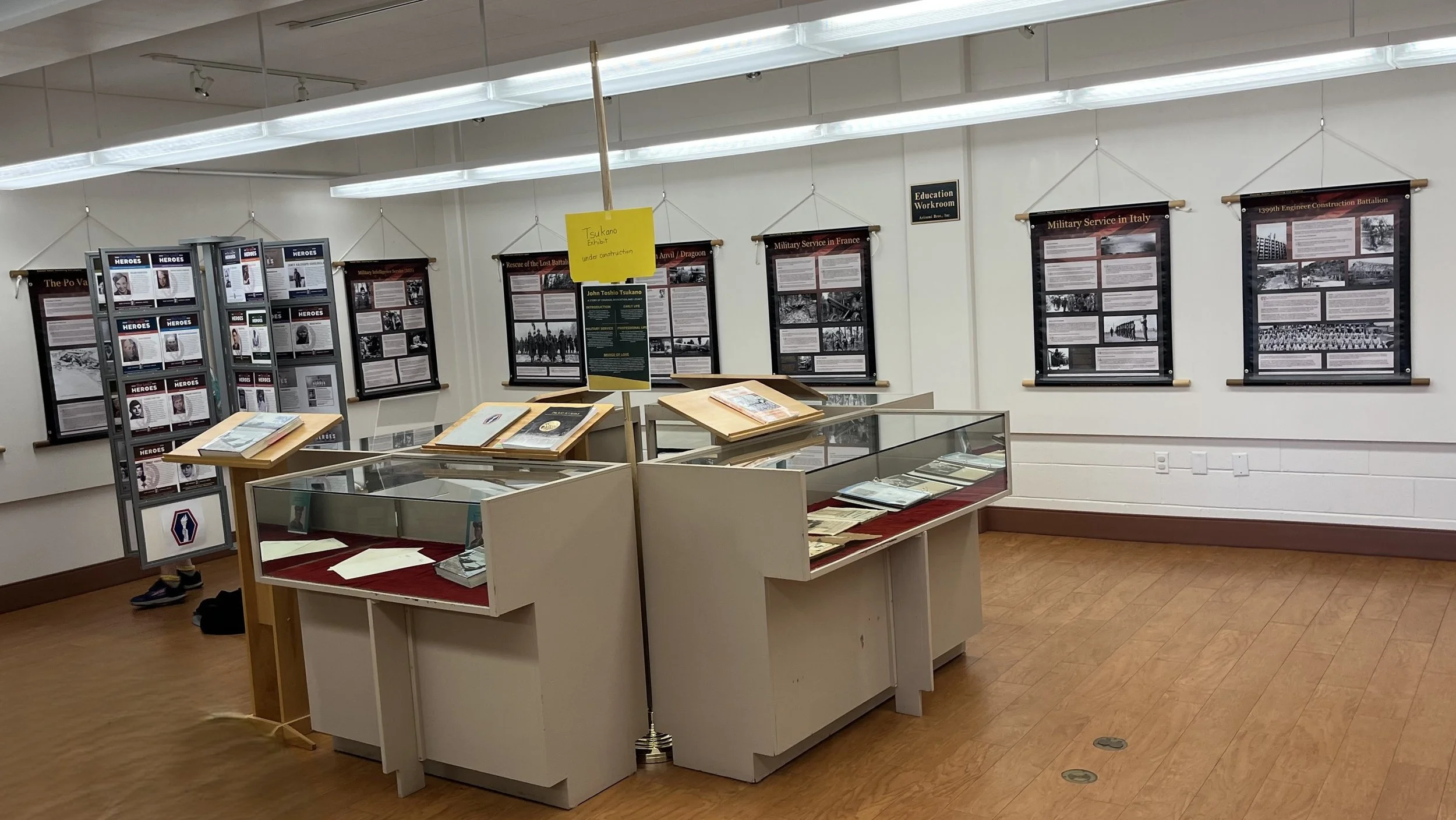
The exhibit room of the NVMC’s Education Center. When we visited in January 2026, it featured 14 wall-hung panels of text + photographs about the Nisei veterans’ combat service in World War II. (photo: Corinne Kennedy)
Our 2026 Visit to the Education Center:
My husband and I visited the Leonard Oka Education Center in mid-January 2026. It includes a large exhibition room as well as the center’s archives. When we visited, the main exhibit consisted of 14 informative and deeply moving wall-hung panels of text + photographs that presented an in-depth history of the World War II service of Maui’s Nisei soldiers. Highlights were the 1942 formation in Hawai’i of the all-AJA 100th Infantry Battalion and the 1943 formation of the 442nd Regimental Combat Team (AJA volunteers—about 2/3rd from Hawai’i and 1/3rd from the U.S. mainland). In 1944, the 100th Battalion was attached to the 442nd, and the combined unit, even today, is recognized as the most decorated unit of its size and length of service in U.S. military history.
We appreciated the time that docent Floyd Nagoshi spent with us, discussing the content and significance of each panel, sharing stories, and answering our questions. Although I had some previous knowledge of Hawai’i Nisei veterans, touring the center with Nagoshi was transformative—revealing the Nisei soldiers’ courage, resilience, sacrifice, and endurance—and the loyalty they had proven by enlisting, despite the discrimination and injustice that they and their families had experienced.
Here’s a brief list of the story elements so eloquently presented in this exhibit:
The Dec. 7, 1941 attack on Pearl Harbor; the imprisonment of AJA community leaders at Sand Island Detention Center; declaration of martial law in Hawai’i; Executive Order 9066 (resulting in the imprisonment of mainland Japanese Americans in 10 concentration camps); formation in Hawai’i of the 100th Infantry Battalion; formation of the 442nd Regimental Combat Team; training at Camp Shelby; the 1399th Engineer Construction Battalion; military service in Italy and France; the 442nd Antitank Company; rescue of the “Lost Battalion” in France (saving 211 Texas National Guardsman while suffering more than 800 casualties); the Military Intelligence Service (MIS); discovery of a Nazi death camp; breaking Germany’s “Gothic Line;” war’s end; legacy of the Nisei veterans.
Nagoshi is a member of the Maui Sons and Daughters of the Nisei Veterans and a past member of the NVMC’s Board of Directors. He served with the U.S. Army in Vietnam, and his father, Noboru Nagoshi, served with the 442nd Regimental Combat Team in WWII.
Other Exhibits:
When we visited, other exhibits included vertical racks with smaller interpretive panels memorializing individual Nisei soldiers. Here is one example, with information about the life and service of John Toshio Tsukano. He survived the war and later wrote The Bridge of Love about the Nisei soldiers’ WWII experiences. Published in 1985, it’s a tribute to their wartime sacrifices and enduring legacy. The center also features a “wall of honor” that lists the Maui Nisei soldiers who were killed in action in Europe during World War II.
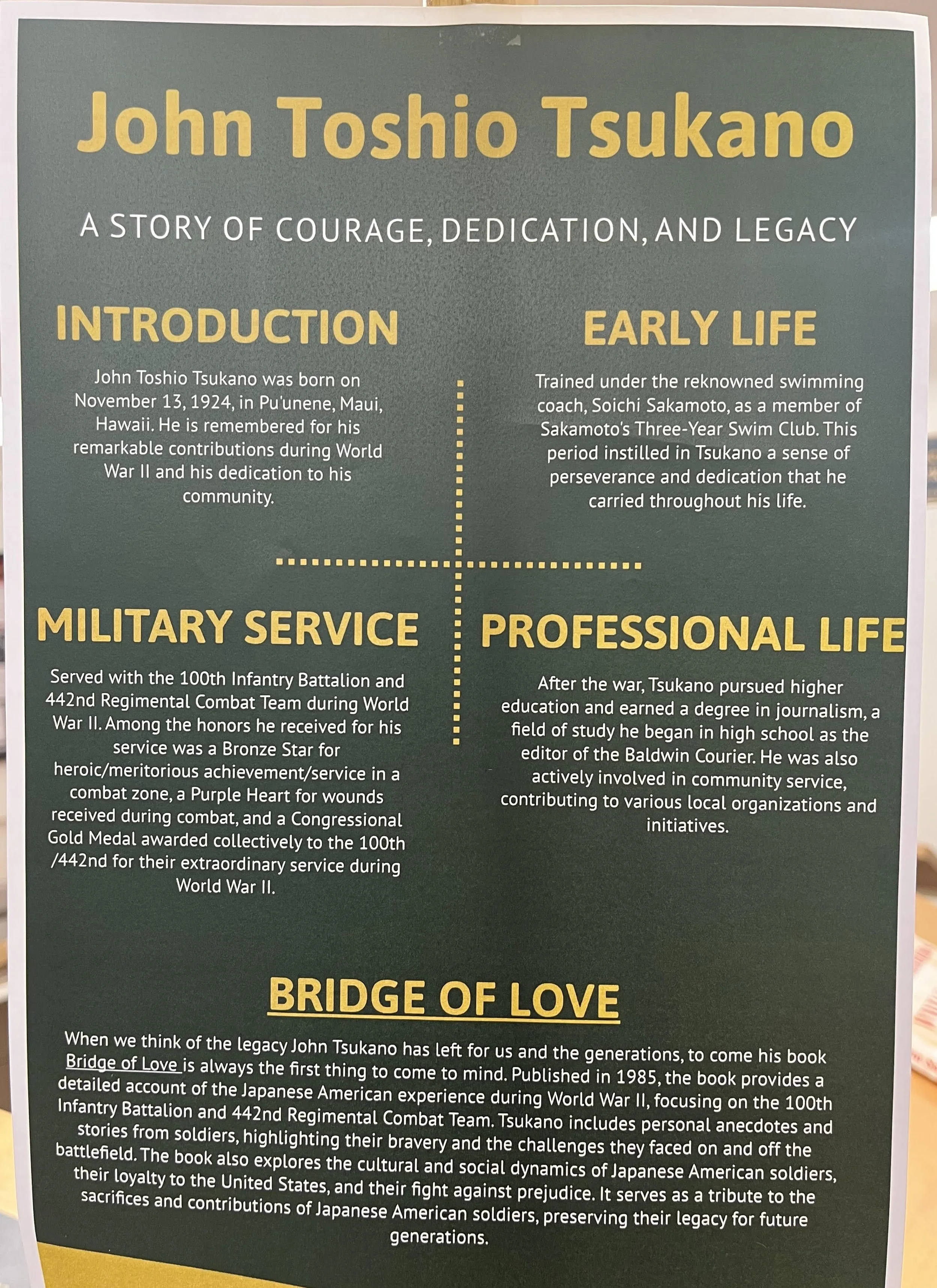
Interpretive panel with information about John Toshio Tsukano’s life, combat service, and writings. (photo: Corinne Kennedy)
More than a dozen books and other items are available for purchase at the Education Center, which is currently open on Monday, Tuesday, Thursday and Friday, from noon to 3:30 p.m. There is no admission charge, but donations are gratefully accepted.
Open hours may change, so prospective visitors are advised to check the NVMC’s website (nvmc.org) or call (808) 244-6862 for information about current hours and exhibits.
I hope that the deep learning fostered by the center’s work and exhibits will continue to inform my future research into the history of Nisei veterans and Americans of Japanese Ancestry, in Hawai’i as well as on the U.S. mainland.
Corinne Kennedy is a Garden Guide, frequent contributor to the Seattle Japanese Garden blog, and retired garden designer.